Growing a Shopify app is becoming increasingly challenging. Because of the competition of 15,000+ apps in this market. Thousands of apps compete for the same merchants, and paid ads are becoming more expensive.
That’s why content marketing for Shopify app growth is now one of the most powerful ways to boost installs and revenue. It works even if you have a small team or a limited budget.
Content marketing helps merchants discover your app, trust your solution, and understand how it solves their problems. When you publish helpful guides, tutorials, and case studies, you attract high-intent traffic without spending on ads. Merchants learn from you, rely on your advice, and naturally choose your app.
Shopify apps that use content marketing consistently see long-term results. That’s why big apps like Judge Me, Loox, Pagefly, GemPages, etc, focus on content marketing as one of the main acquisition channels.
In this post, I will guide you on how to use content marketing to grow your Shopify app step-by-step. Even if you’re just getting started or have a small team with a minimum budget.
Let’s get started!
Importance of Content Marketing for Shopify App Growth
Content marketing helps Shopify app developers reach merchants without cost, build trust, and explain your app’s value. It drives long-term traffic, improves conversions, and reduces dependency on paid ads.
Key benefits:
- Attracts high-intent merchants searching for solutions.
- Helps merchants understand your app through real examples and tutorials
- Improves retention by educating users after installation
- Builds authority and trust in your app category, which is a long-term benefit.
- Strengthens brand visibility across multiple channels.
- Creates steady traffic from organic sources that compounds over time.
- Supports other channels like email, social media, and partnerships.
- Position your app as an expert solution in your target industry.
- Boosts trust with case studies, success stories, and Shopify app reviews.
- Reduces CAC by replacing expensive ads with sustainable growth.
Types of Content That Work Best for Shopify App Marketing
Content marketing works best when you create valuable content for different platforms. Don’t create content only for your brand; instead, create content for the merchant’s solution.
Many Shopify app founders create just one piece of content, then try to publish the same content everywhere. But user behavior is not the same for all platforms, that’s why you need to create based on your target platform.
Let’s uncover which types of content marketing work best for Shopify app marketing:
1. Website Content for Your Shopify App Growth
Your website is the strongest asset in your content marketing strategy. It’s the first place merchants visit when they want to understand how your Shopify app works.
From my experience working with multiple Shopify apps, clear landing pages always convert better than long feature pages.
So, your homepage, landing page, and pricing comparison should explain what your app does, who it helps, and why it is better than alternatives. Add FAQs, use-cases, partner page, integration pages, and highlight benefits rather than features.
Focus on clarity. Merchants don’t have time to understand complicated text. Use short sentences and simple visuals that are relatable. Strong, targeted website content builds trust and increases install rates.
2. Blog Posts Writing with a Proper Strategy
A blog is one of the most powerful tools for driving long-term growth of Shopify apps. I wrote a few articles for ShopiDevs in 2024 to grow the Slider Revolution. After more than a year, without any modification or time spent, we are getting organic installations from that content.
Not mandatory that blogs drive visitors from direct blog posts; they also help to get featured on AI tools like ChatGPT. When you write blog posts, LLMs will learn more about your product and will recommend your app to merchants.
I’ve seen multiple apps increase installs 3–10x by publishing helpful content consistently. Write blogs that solve merchant problems, explain workflows, or compare solutions.
So, cover topics that merchants search for every day. For example, “how to increase conversions,” “how to speed up a Shopify store,” or “best Shopify apps for upselling.” These attract high-intent users who are already looking for solutions.
Blogs are not just for traffic; they build authority, keep users engaged, and push them naturally toward installing your app.
3. Long-Form Video Content and Tutorials
Long-form videos show your expertise better than any other content format. When merchants see you explain your app, features, or strategies live on-screen, it builds a strong sense of trust.
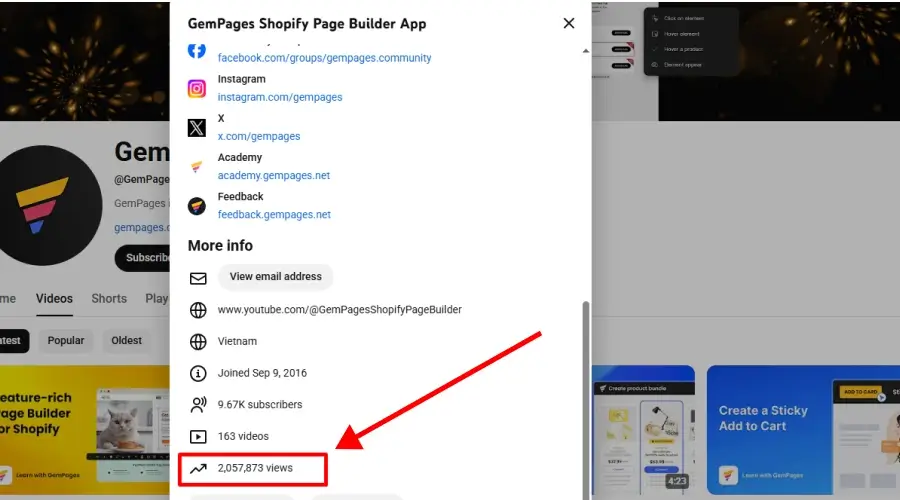
Big landing page builder Shopify apps like GemPages or PageFly are getting consistent views and installations from their YouTube channels. This is not only about acquiring users for one time; if you create long-form videos, it also helps to build authority.
Additionally, 10–20 minute tutorial videos cut support tickets by more than half because users learn visually and feel confident to use your app.
So, create videos that demonstrate real use-cases, step-by-step setups, and detailed feature walkthroughs. Merchants appreciate transparency and clarity.
Well-structured tutorials also rank on YouTube and help new merchants discover your app organically. Over time, your YouTube library becomes a searchable knowledge base.
4. Short-Form Video Content
Short-form videos are the fastest way to reach new merchants. I know a Shopify app, Kaching Bundles, has created only short-form videos for TikTok and Instagram for 60 days.
The result?
They got more than 135 installations from only short-form videos. Platforms like TikTok, YouTube Shorts, and Instagram Reels push videos aggressively.
You can share quick tips, before-and-after results, or fast feature highlights. Make your videos simple and to the point. Merchants love content that solves a problem in under 30 seconds.
5. UGC & Merchant Co-Created Content
User-generated content is one of the strongest trust-building ways for Shopify apps. When real merchants share how your app helped them boost conversions or save time, it becomes powerful social proof.
I always encourage apps to collect screenshots, videos, and small testimonials. These add authenticity and make your marketing more relatable.
Collaborate with your users to create tutorials, walkthroughs, or mini case studies. Co-created content feels natural and unbiased. It also increases engagement because merchants trust merchants, not marketing teams.
6. Email Newsletter Content
Email marketing helps you stay connected with merchants even after they leave your website. A well-written newsletter builds authority, strengthens trust, and increases retention. Share product updates, new features, educational content, and small tips.
According to my experience with newsletters, short and value-packed emails always perform better than long promotional emails.
Use email sequences to onboard new users, guide them through features, and solve common problems. A strong email flow can increase your trial-to-paid conversion rate by 20–40%. Email marketing also helps you turn one-time users into long-term customers.
7. Community Answers & Q/A Content
Communities like Reddit, Quora, Facebook Groups, and Shopify Community Forums are underrated but extremely powerful. Merchants ask real questions daily, and answering them positions you as an expert.
I’ve used Shopify community and Reddit answers to drive targeted, high-intent traffic to Shopify apps. When you answer questions honestly and provide practical solutions, merchants start trusting your brand.
However, avoid being pushy. Share helpful insights, then mention your app naturally when it fits. Over time, community visibility creates strong authority and stable traffic to your app.
Remember to maintain community guidelines and rules to stay safe from getting your account banned.
8. Press, PR & Guest Posts
Press mentions and guest posts help build your brand authority. Writing for trusted websites instantly boosts credibility and builds strong backlinks for SEO. Shopify merchants trust apps that appear in reputable industry publications. It signals reliability and professionalism.
Guest posts also expose your app to large, established audiences. Share unique insights, product stories, or data-backed articles. When people see your expertise outside your website, they develop more confidence in installing your app.
9. Webinars, Events, and Live Workshops

Live webinars and workshops help merchants see your app in action. If you see one of the most successful affiliate marketing apps, UpPromote, they regularly arrange live webinars.
This helps them to educate how merchants can utilize affiliate marketing on their store using UpPromote. If you do so, merchants will understand your expertise in the industry, and they will trust your Shopify app.
Another good option to build authority is joining on-site events for Shopify. Not necessarily, it always should be official Shopify events.
It could be third-party events arranged by any app company, Shopify merchants, or anyone in the Shopify community. These sessions build deeper trust because merchants interact with you personally.
You also get instant feedback and understand what users really want. Webinars, events, or workshops can convert highly interested leads into new customers faster than written content.
10. Case Studies & Success Stories
Case studies prove your Shopify app delivers real results. They show before-and-after numbers, real store screenshots, and specific outcomes. Merchants rely heavily on proof. I’ve seen case studies improve conversions because they reduce doubt and accelerate buying decisions.
Tell stories clearly: the challenge, the solution, and the results. Highlight measurable improvements such as “40% increase in conversions” or “20 hours saved per week.” These stories show your expertise and make your app’s value undeniable.
How Content Marketing Helps Shopify App SEO
Content marketing is one of the strongest ways to improve Shopify App Store Optimization (SEO). When you publish the right content, merchants can discover your app faster. Also, search engines trust your brand more, and your listing naturally ranks for more keywords.
High-quality content increases your brand visibility across Google, Bing, ChatGPT, Gemini, Perplexity, and other LLMs. Also, it helps to discover your app through YouTube, social media, and community platforms.
More visibility creates more branded searches. And Shopify loves branded searches. It’s a signal that merchants already know your app and want to find it. This helps your app move up in rankings for both primary and relative keywords.
Content marketing also builds topical authority. If your app solves SEO issues, performance issues, or marketing problems, Google and merchants expect you to publish content around those topics.
When you do, your app becomes a trusted expert. Over time, this authority improves both web ranking and app store visibility.
Another advantage of content marketing is conversion. Helpful content guides merchants, educates them, and reduces confusion. When merchants understand your value through blogs, videos, and tutorials, they are more confident in installing your app.
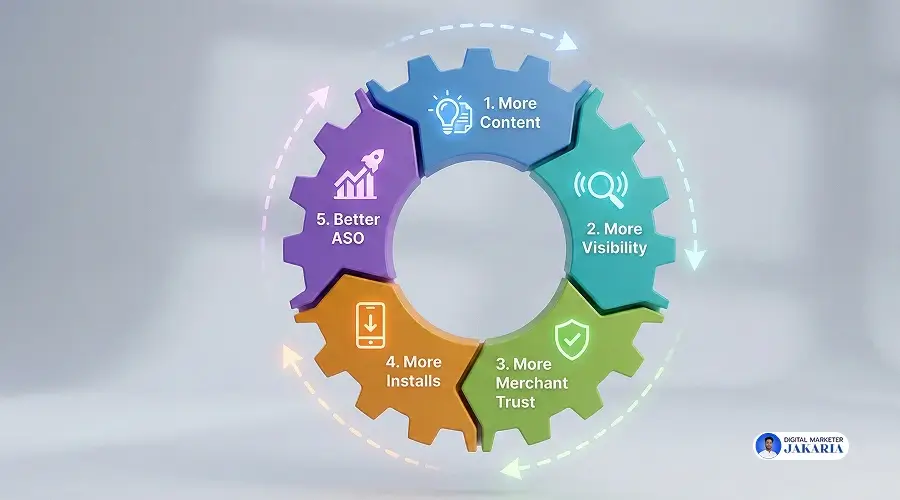
In simple words: More content → More visibility → More merchant trust → More installs → Better ASO.
Content Marketing Checklist for Shopify App Growth
Content marketing does not have to be complicated. A simple system can bring consistent installs. Use this checklist to stay organized and move fast.
| Category | Checklist Item | What to Do | Why It Matters |
| Audience & Strategy | Define ICP (Ideal Customer Profile) | Identify merchant types, store sizes, industries, and pain points. | Helps create hyper-targeted content that converts. |
| Map Customer Journey | Outline TOFU (Top), MOFU (Middle), and BOFU (Bottom) funnel stages. | Ensures content aligns with the buyer’s intent. | |
| Core Content Assets | Optimize App Listing Page | Improve title, tagline, descriptions, features, FAQs, and screenshots. | Increases rankings, installs, and CTR (Click-Through Rate). |
| Build Website/Landing Page | Create a standalone SEO page explaining the app’s value. | Captures organic traffic beyond the App Store. | |
| Create Feature Blogs | Write articles addressing specific problems your app solves. | Improves topical authority & organic reach. | |
| Publish Use Cases | Showcase real merchant workflows and solutions. | Converts educated buyers faster. | |
| Authority & Trust | Case Studies | Publish results-driven stories with hard metrics. | Builds credibility and drives conversions. |
| Testimonials & UGC | Collect video and text reviews from current merchants. | Social proof improves trust and install rates. | |
| Video Content | Long-Form Tutorials | Create setup guides, demos, and deep-dive walkthroughs. | Reduces friction and supports conversions. |
| Short-Form Videos | Make TikTok/Reels/YT Shorts with quick tips. | Boosts discoverability and app awareness. | |
| Email & Community | Launch Email Newsletter | Send product updates, tips, and industry insights. | Retains users and boosts feature adoption. |
| Contribute to Communities | Answer questions on Shopify Community, FB Groups, Reddit, and Quora. | Builds expertise and generates passive traffic. | |
| Distribution | Social Media Sharing | Share blogs, videos, and case studies consistently. | Expands reach across multiple channels. |
| Guest Posting & PR | Get featured on industry blogs and podcasts. | Strengthens backlinks and E-E-A-T (Authority). | |
| Optimization | Keyword Optimization | Research keywords for app listing, blogs, and pages. | Boosts search visibility across all platforms. |
| Track Metrics | Monitor installs, conversion rate, top pages, and retention. | Ensures the content strategy is actually working. | |
| Maintenance | Update Content Monthly | Refresh blogs, videos, and app listing details. | Keeps rankings stable and content relevant. |
| Repurpose Content | Turn blogs into videos, and videos into social posts. | Saves time while maximizing content reach. |
Content Distribution for Shopify App Marketing
Creating content is only half the work. The real growth begins when you distribute it to the right places. Distribution ensures that your content reaches Shopify merchants, rather than remaining invisible to them.
You can start by repurposing each piece of content. One blog post can be repurposed into email content, social posts, short videos, and community answers. This multiplies your visibility without creating new content from scratch. Repetition is not bad; it reinforces your message.
Each platform brings a different type of merchant. Some are researching, some are learning, and some are ready to install an app. When you show up everywhere, you capture all stages of the funnel.
Use your own website as the main hub and landing page. So, publish the content on your website first. Then link back to it from every platform. Over time, this increases your domain authority and grows your search presence. Even one strong distribution routine can bring consistent installations.
You can also collaborate with influencers, Shopify experts, or agencies. Let them test your app and share their experience. External voices bring trust, and trust brings installs. Distribution is the engine that turns content into real growth.
Mistakes to Avoid in Shopify App Content Marketing
Content marketing can boost your Shopify app’s visibility, but small mistakes can slow your growth. Avoiding these issues helps you attract the right merchants, build trust, and drive more installs with less effort.
- Creating content without a clear target merchant or ICP.
- Focusing only on the Shopify App Store listing and ignoring other content channels.
- Writing feature-heavy content instead of solving merchant problems.
- Ignoring keyword research and merchant search intent.
- Skipping TOFU, MOFU, and BOFU content for the full customer journey.
- Leaving old content outdated without regular updates.
- Publishing content without a proper distribution strategy.
- Not using merchant stories, case studies, or UGC for social proof.
- Creating content without tracking performance or analytics.
- Over-optimizing content with keywords and hurting readability.
Conclusion
Content marketing is one of the easiest and most reliable ways to grow a Shopify app. Whether you are a solo developer or running a full team, content marketing can help merchants find your app.
When you share useful tutorials, blog posts, videos, and real customer stories, merchants will be confident in how your app impacts their store growth. This kind of content builds trust, improves your Shopify App Store rankings, and attracts organic installs over time.
The best part is that content keeps working even when you’re not promoting your app. One strong article or video can bring installs for months. And when you combine content with smart distribution, you create a steady growth system that keeps improving.
Start with simple content. Focus on helping merchants. Stay consistent. If you do that, content marketing will slowly turn into one of your strongest sources of traffic, installs, and revenue for your Shopify app.
If you want to grow your app without spending a lot on ads, you should start content marketing today!
Don’t have time to create content or are unsure where to start?
Let’s Discuss In Details
FAQs
1. What is Content Marketing for Shopify Apps?
Content marketing for Shopify apps means creating helpful content to educate merchants, build trust, and drive more installs. It includes blogs, videos, tutorials, emails, and social content that explain your app’s value.
2. Why is Content Marketing Important for Shopify App Growth?
Content marketing is important for Shopify app growth because merchants search for solutions before installing an app. Good content builds authority, clarifies their questions, and shows how your app solves real problems. This increases installs and improves App Store ranking.
3. What Type of Content Works Best for Shopify App Marketing?
Blog posts, tutorials, videos, case studies, UGC, community answers, and email content work best for Shopify apps. These formats help merchants learn, compare, and trust your app before installing it.
4. How Often Should Shopify App Developers Publish Content?
You should publish at least 2–4 pieces of content per month. If you can create more content, it will be beneficial, but remember consistency & quality matter more than volume. Regular content helps your app stay visible, rank higher, and build long-term authority.
5. Do Small Shopify App Teams Need a Big Budget for Content Marketing?
No. You can start with simple content like blogs, FAQs, community answers, and short videos. As an indie developer, if you have no budget for content, then you can use AI tools to write content. But ensure to input insights and value by editing the content before publishing it.
7. How Long Does It Take to See Results From Content Marketing?
Usually, content marketing takes 4–12 weeks to see installs from this channel. Content takes time to index, rank, and attract traffic. But once it starts working, it brings installs without extra cost.