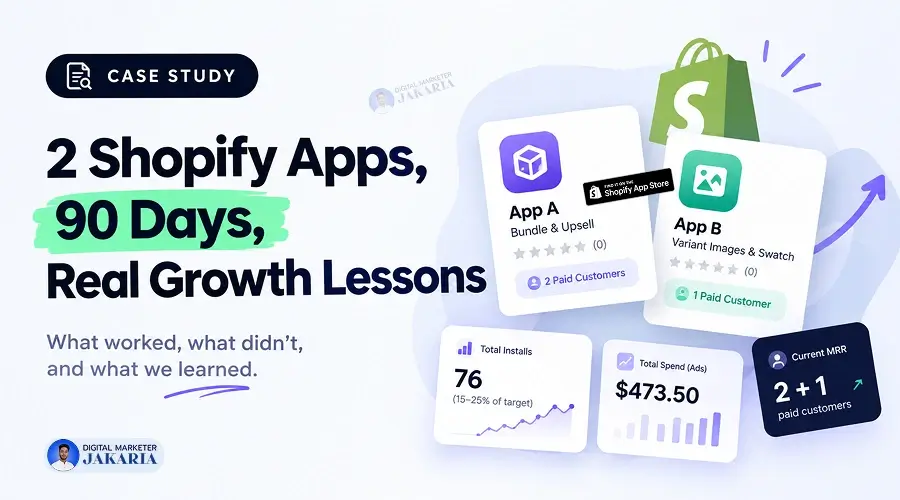
This is not just a successful Shopify App Growth case study. This was a completely different project for my team and me, and it taught us a lot.
Yes, we have managed Shopify app listing ASO, Shopify App Store Ads, SEO, content, localization, analytics, etc. However, I have found some strategic constraints that can prevent a new app from scaling. I will share everything in detail after the project overview below:
Client: Anonymous Shopify App Company
Engagement: Shopify App Growth Program
Duration: Approximately 90 days
Services: Complete Growth Suite
Current Status: Engagement postponed
Products: Two newly launched Shopify Apps
Original growth expectation: 300–500 installs
Note on confidentiality: The client, company, app names, URLs, and other identifying details have been anonymized for privacy. The performance data and project observations presented here are based on the actual engagement and available analytics.
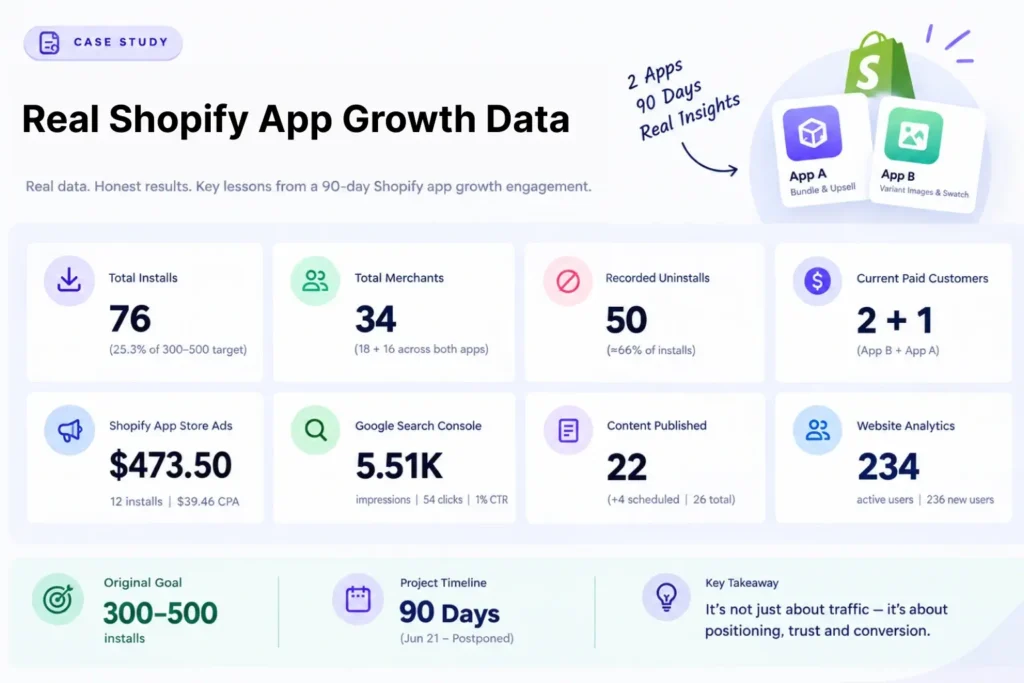
Shopify App Growth Project Snapshot
| Area | Project Data |
| Apps involved | 2 |
| Original install expectation | 300–500 |
| Installs recorded in 90-day Shopify analytics | 76 |
| Recorded uninstalls in the same 90-day window | 50 |
| Current merchants across both apps | 34 |
| Shopify App Store Ads spend | $473.50 |
| Shopify App Store Ads impressions | 16,474 |
| Shopify App Store Ads clicks | 120 |
| Shopify App Store Ads installs | 12 |
| Shopify App Store Ads CPC | $3.95 |
| Shopify App Store Ads cost per install | $39.46 |
| Google Search Console impressions | 5.51K |
| Google Search Console clicks | 54 |
| Google Search Console CTR | 1% |
| Google Search Console average position | 31.7 |
| Website active users | 234 |
| Website new users | 236 |
| App A listing active users | 245 |
| App A listing new users | 333 |
| App B listing active users | 166 |
| App B listing new users | 238 |
| App B average engagement time | 30 seconds |
| App A current paid customers | 1 |
| App B current paid customers | 2 |
The 76 installs represent 25.3% of the lower end and 15.2% of the upper end of the original 300–500 install expectation.
The 50 recorded uninstalls should not be interpreted as a precise churn rate because the Shopify dashboard data is not cohort-based. It is better treated as a directional retention signal within the same 90-day reporting window.
Here is How the Project Started
This project did not begin with a formal marketing proposal. It started with a conversation with the founder.
The initial call happened around May 23, 2026, during Eid travel. At that point, the company had two newly launched Shopify Apps and wanted to build traction in the Shopify App Store.
The expectation was ambitious. They wanted to reach approximately 300–500 installs.
The challenge was that the apps were entering categories where merchants already had many established options. The products were new, the review base was not established, and there was very little historical marketing data available to determine which acquisition channels were actually working.
I could see fairly quickly that this was not simply a traffic problem.
Before trying to generate hundreds of installs, we needed to understand the market, the apps, the existing visibility, the competitive environment, and the conversion path.
Officially Signed the Contract
After the initial conversation, I went on vacation.
Once I returned, we had another three rounds of meetings to discuss the products, marketing requirements, implementation constraints, and the growth expectations.
The project officially started on June 21, 2026.
That distinction matters because the early period was not a long-established marketing operation. These were new products entering competitive Shopify App Store categories, and the available historical data was limited.
For one of the apps, historical tracking had not been properly established before the engagement.
So one of the priorities was measurement.
The Starting Point: 2 Apps
Two New Apps Entering Crowded Categories
Honestly, I didn’t marketing for a company with completely new Shopify apps in a very competitive app category. So these two apps were super exciting for me.
The company had two products.
For confidentiality, I will refer to them as:
- App A: Bundle and Upsell App
- App B: Variant Images and Swatch App
Both products were entering categories with established competitors and existing merchant expectations.
The challenge was not simply getting discovered.
Merchants already had alternatives.
That meant the products needed to compete across several dimensions:
- App Store visibility
- Search relevance
- Listing quality
- Trust
- Reviews
- Differentiation
- Conversion
- Product experience
- Distribution
App B Baseline
The clearest baseline data was available for App B.
At the starting point, it had:
- 6 active merchants
- 39 all-time installs
- 33 all-time uninstalls
- 0 reviews
- $0 MRR
- 380 indexed keywords
- 2 keywords in positions 1–4
- 31 keywords in positions 5–24
- 246 Product Variant category keywords
- 136 Image Gallery category keywords
- 45 indexed website pages
- 22 articles published
- 4 articles scheduled
- 26 articles planned in total
The lack of reviews was particularly important.
A merchant evaluating a new Shopify App has to decide whether the product is worth installing and trusting. With zero reviews, the listing had limited social proof to support that decision.
App A Had a Different Measurement Problem
For App A, historical tracking had not been properly established before the engagement.
That created another problem.
Without reliable historical analytics, it was difficult to determine where growth was coming from or compare performance against a meaningful baseline.
So I implemented Google Analytics 4 and Google Search Console tracking for the relevant websites and established better measurement around the apps and their acquisition activity.
That gave us something much more valuable than isolated traffic numbers.
It gave us a way to start understanding the relationship between:
Visibility → Listing Visits → Installs → Merchants → Paid Customers
The Growth Target We Set
The business expectation was approximately:
300–500 installs.
That became the headline acquisition target.
But I did not want to treat installs as the only definition of growth.
An install has limited business value if the merchant does not activate, remain, or eventually become a paying customer.
So the broader question became:
Can we create enough qualified demand for these apps, and can the products convert that demand into sustainable merchant and revenue growth?
That question shaped the work that followed.
My Diagnosis – Key Challenges We Faced
#1st Problem Was the Market
Both products operated in highly competitive categories: “Bundle & Upsell” and “Image Variant”.
Established competitors had already accumulated years of:
- Merchant relationships
- Reviews
- Brand recognition
- Search visibility
- Content
- Product maturity
- Distribution
- Social proof
The new apps did not have those advantages.
This created a difficult starting position.
#2nd Problem Was Differentiation
The products did not have a strong enough unique positioning.
They were solving legitimate merchant problems, but there was not yet a compelling reason for a merchant to choose these products over established alternatives.
That changes the marketing problem.
If the product is essentially competing on feature parity, marketing has to work much harder to create demand.
#3rd Problem Was Trust
At the beginning, the apps had 0 reviews.
There was also limited social proof and no established community around the products.
This meant that even when a potential merchant discovered an app, there was limited third-party evidence supporting the purchase or installation decision.
#4th Problem Was Distribution
The acquisition strategy was not yet omnichannel.
There was no strong video acquisition engine, limited community presence, and no mature ecosystem of external distribution channels.
The website and Shopify App Store could generate discovery, but they were not yet supported by a broader demand-generation system.
#5th Problem Was SEO Authority
Content production was underway.
However, content volume alone was not enough.
The project had limited resources for technical SEO improvements and no link-building campaign because of budget constraints.
That meant the website could publish useful content without necessarily building enough authority to compete consistently for valuable commercial search terms.
#6th Problem Was Conversion Validation
This became one of the most important strategic findings.
Before aggressively increasing paid acquisition, we needed stronger evidence that additional traffic and installs would translate into valuable merchants and revenue.
That is why Google Ads was considered but not implemented during this engagement.
The question was not:
“Can we buy more traffic?”
The question was:
“If we buy more traffic, do we have enough evidence that the resulting acquisition economics will make sense?”
That distinction prevented the project from simply increasing spend before the product and funnel had been sufficiently validated.
What We Worked On
Shopify App Store Optimization
The first major workstream was App Store optimization.
This included:
- Keyword research
- Search intent analysis
- Listing optimization
- App positioning
- Metadata improvements
- Localization
- Competitive analysis
- App Store visibility analysis
The goal was not to insert keywords randomly.
The goal was to improve the relationship between:
Merchant problem → Search intent → App Store relevance → Listing → Install
Shopify App Store Ads
We also tested paid acquisition through Shopify App Store Ads.
The campaign generated measurable traffic and installs.
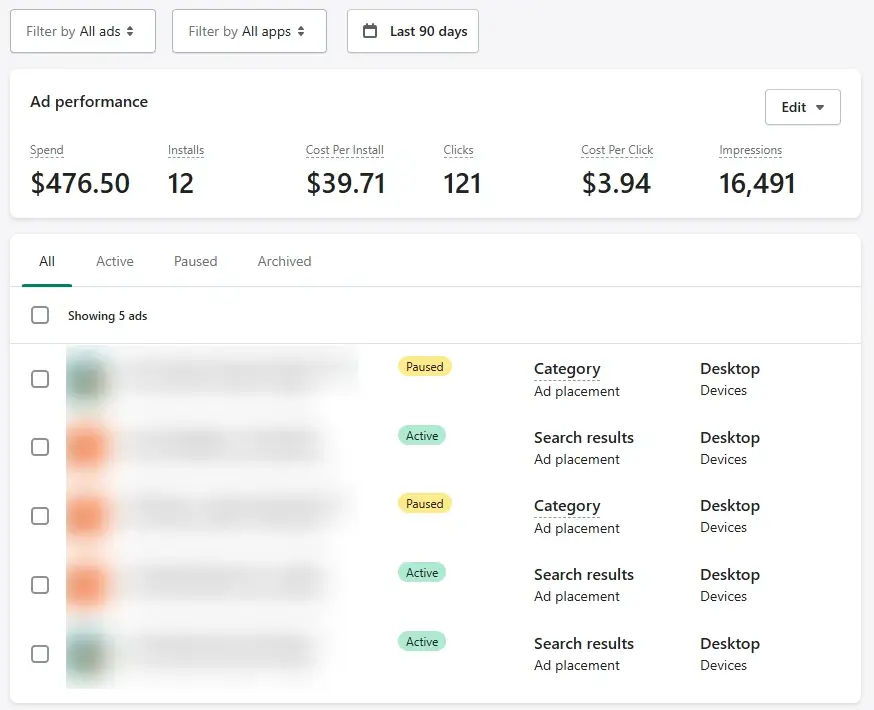
The 90-day dashboard snapshot recorded:
- $473.50 spend
- 16,474 impressions
- 120 clicks
- $3.95 CPC
- 12 installs
- $39.46 cost per install
That works out to approximately:
- 0.73% impression-to-click rate
- 10% click-to-install rate
The important conclusion was not that Shopify App Store Ads were ineffective.
The data simply did not provide enough evidence that the acquisition economics were ready to support aggressive scaling. But we found high valuable search terms from the campaign which will definitely help them to scale in future.
The campaign demonstrated that paid acquisition could generate attention and installs.
It did not yet demonstrate a sufficiently validated path from paid acquisition to profitable recurring revenue.
SEO and Content
SEO became another major workstream.
The website was improved, including:
- On-page SEO
- Website structure
- Important business pages
- Privacy and terms pages
- Analytics implementation
- Search Console implementation
- Content development
Approximately 22 articles had been published, with 4 additional articles scheduled, bringing the planned content set to 26 articles.
However, the strategy was not simply to publish as many articles as possible.
The goal was to build search visibility around relevant Shopify merchant problems and product categories.
Search Performance
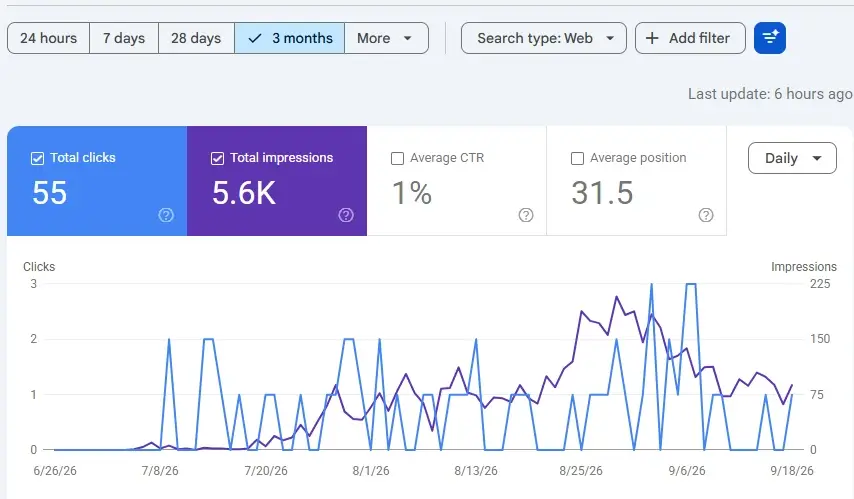
The three-month Google Search Console snapshot showed:
- 5.51K impressions
- 54 clicks
- 1% average CTR
- 31.7 average position
This showed that Google was beginning to surface the website.
But visibility was still relatively early-stage.
An average position of 31.7 meant that much of the search visibility was occurring outside the strongest organic result positions.
The data supported a clear conclusion:
Content was creating search visibility, but the website still needed stronger authority, commercial intent coverage, and conversion infrastructure before organic traffic could become a predictable acquisition channel.
Analytics and Measurement
Another important part of the project was measurement.
Google Analytics 4 and Google Search Console were implemented so that the team could better understand:
- Website acquisition
- Search visibility
- App listing traffic
- New users
- Active users
- Engagement
- Install activity
This mattered because growth decisions without measurement quickly become assumptions.
What the 90-Day Data Showed
App A Performance
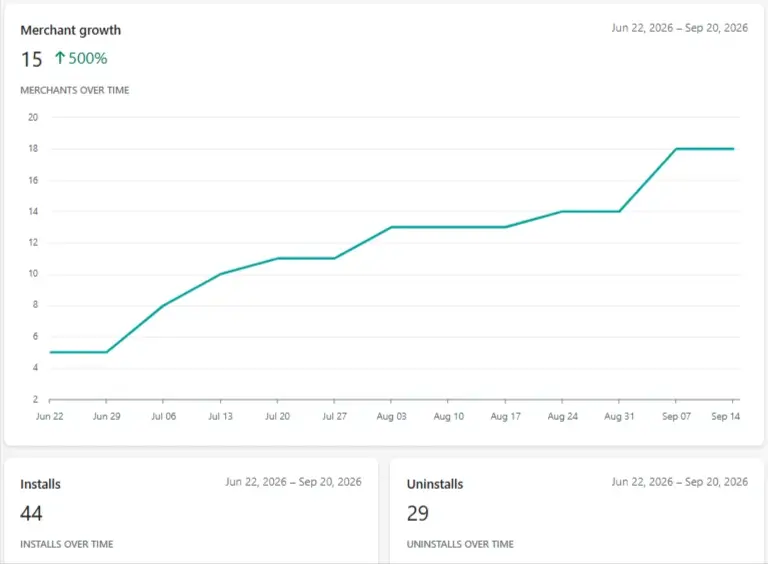
During the 90-day Shopify analytics snapshot, App A recorded:
- 44 installs
- 29 uninstalls
- 18 merchants
- Merchant growth: +500%
The merchant-growth chart moved from approximately 3 merchants to 18 merchants during the reporting period.
The app listing also recorded:
- 245 active users
- 333 new users
This indicates that the listing was receiving meaningful discovery traffic even though the app was still early in its lifecycle.
App B Performance
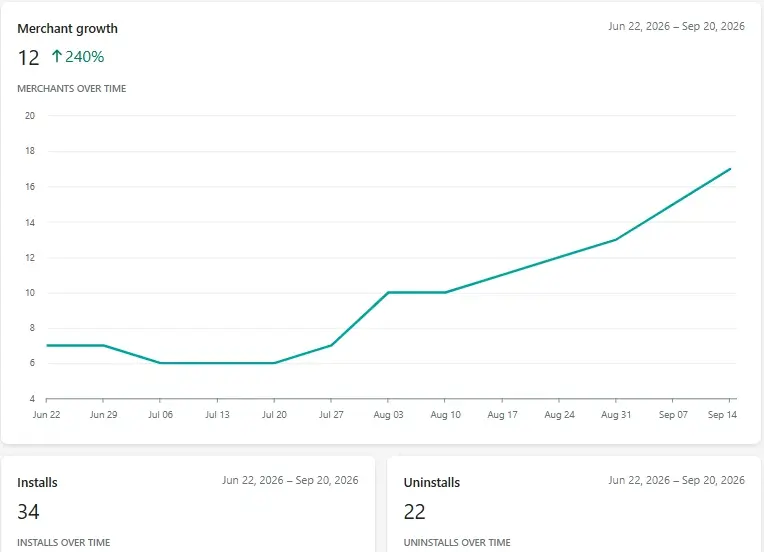
During the same 90-day Shopify analytics snapshot, App B recorded:
- 32 installs
- 21 uninstalls
- 16 merchants
- Merchant growth: +220%
The merchant-growth chart moved from approximately 5 merchants to 16 merchants.
Its listing recorded:
- 166 active users
- 238 new users
- 30 seconds average engagement time per active user
Again, these numbers show that the product was being discovered.
The more important question was what happened after discovery.
Combined App Performance
Across both apps:
- 76 installs
- 50 recorded uninstalls
- 34 merchants
The recorded uninstall-to-install ratio was approximately 65.8% within the same dashboard window.
I would not describe that number as a formal churn rate because the dashboard data is not cohort-based.
It is better understood as a directional signal that raised an important question about merchant retention and product-market fit.
The original target was 300–500 installs.
The project recorded 76 installs in the 90-day Shopify analytics snapshots.
That means acquisition reached:
- 25.3% of the 300-install target
- 15.2% of the 500-install target
So the engagement did not reach the original acquisition target.
But the data revealed something more strategically useful than simply saying “the target was missed.”
It showed where the constraints were.
Website and Listing Traffic
Website Traffic

The website analytics snapshot recorded:
- 234 active users
- 236 new users
This provided a baseline for the broader website acquisition engine.
The website was generating discovery, but traffic volume alone was not yet large enough to establish a predictable acquisition system.
App A Listing Traffic
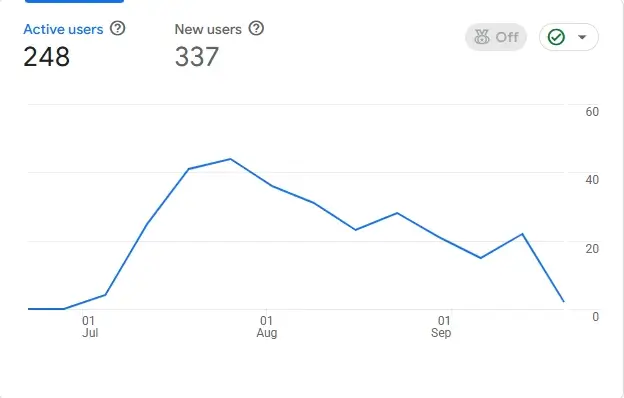
App A recorded:
- 248 active users
- 337 new users
This showed that merchants were reaching the app listing.
The problem therefore could not be framed simply as “nobody is finding the app.”
The more useful question became what happened between listing discovery and valuable merchant adoption.
App B Listing Traffic
App B recorded:
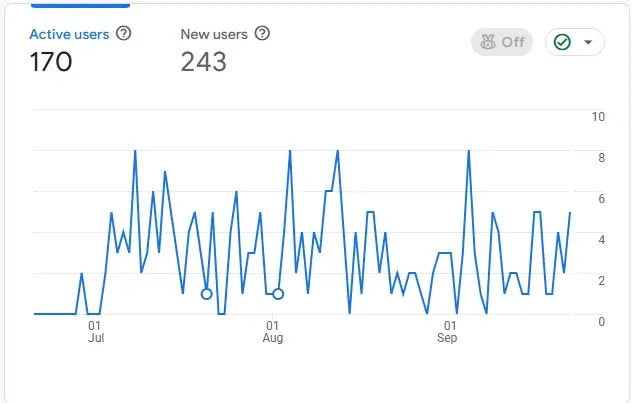
- 166 active users
- 238 new users
- 30 seconds average engagement time per active user
Again, the listing was receiving visitors.
This reinforced the importance of evaluating the full funnel rather than treating traffic as the final marketing KPI.
Paid Customer Status After 90 Days
App B
At the latest project status, App B had:
2 paid customers.
App A
At the latest project status, App A had:
1 paid customer.
This is important context when interpreting the earlier $0 MRR baseline.
The initial data showed no MRR at the starting point. The latest status now shows paid customers on both products.
What We Learned From the Project
My team has learned a lot from this project, because these 2 apps were completely newborn in a competitive category.
Lesson 1: Acquisition Was Not the Only Problem
The biggest lesson from this engagement was that acquisition should not automatically be treated as the primary growth constraint.
The apps could generate:
- Search visibility
- Listing traffic
- Installs
- Merchants
But those signals did not yet prove that scaling acquisition would create sustainable revenue growth.
That is why simply increasing advertising would have been the wrong strategic response.
Lesson 2: Traffic Does Not Solve Positioning
The apps entered competitive categories without a sufficiently strong differentiation story.
That made every acquisition channel harder.
SEO has to compete for attention.
Paid acquisition has to compete for clicks.
The App Store listing has to compete for installs.
The product itself has to compete for retention.
When the market already contains established alternatives, positioning becomes part of acquisition economics.
Lesson 3: Reviews Are a Growth Asset
The initial 0-review position was not simply a cosmetic issue.
Reviews affect trust.
Trust affects conversion.
Conversion affects acquisition economics.
That means review generation should be treated as part of the growth system, not as an isolated App Store optimization task.
Lesson 4: Content Volume Is Not the Same as Organic Growth
Publishing 22 articles, with another 4 scheduled, created a meaningful content base.
But the Search Console data showed only:
- 5.51K impressions
- 54 clicks
- 1% CTR
- 31.7 average position
That demonstrated why content production needs to be combined with:
- Search intent
- Commercial relevance
- Internal linking
- Authority
- Technical SEO
- Distribution
- Conversion optimization
Publishing more pages is not automatically the same as building an organic acquisition engine.
Lesson 5: Paid Acquisition Should Follow Conversion Validation
The Shopify App Store Ads test spent $473.50 and generated 12 installs at a $39.46 cost per install.
That is useful acquisition data.
But install acquisition alone does not answer the commercial question.
The real unit economics need to connect:
Ad Spend → Install → Activation → Paid Conversion → Retention → MRR
Without that chain, scaling spend can simply scale uncertainty.
Lesson 6: Product-Market Fit Changes Marketing Economics
This was perhaps the most important lesson.
A marketing channel can perform exactly as designed and still fail to create attractive business economics.
A campaign can generate clicks.
An App Store listing can generate installs.
SEO can generate impressions.
But if the product does not have a strong enough reason to win against established alternatives, acquisition becomes increasingly expensive.
Marketing cannot permanently compensate for weak differentiation.
The Strategic Framework I Would Use Going Forward
1. Diagnose
Before increasing acquisition, establish:
- Market demand
- Competitive intensity
- ICP
- Positioning
- Product differentiation
- Existing traffic
- Install behavior
- Activation
- Paid conversion
- Retention
- Revenue economics
2. Position
Create a clear market wedge.
The goal is not to become another generic bundle app or another generic swatch app.
The goal is to answer:
Why should a specific type of Shopify merchant choose this product instead of the established alternatives?
3. Attract
Once the positioning is stronger, build multiple acquisition channels:
- Shopify App Store SEO
- Shopify App Store Ads
- Google SEO
- Commercial content
- YouTube
- Partnerships
- Communities
- Founder-led distribution
4. Convert
Improve the complete conversion path:
Search → Listing → Install → Activation → Paid Conversion
The app listing is only one part of that journey.
5. Retain
Measure:
- Activation
- Product usage
- Merchant value
- Uninstall behavior
- Paid conversion
- Retention
The goal is not simply more installs.
It is more valuable merchants.
6. Scale
Only after the economics are validated should acquisition be scaled aggressively.
The key metrics become:
- CAC
- Install-to-paid conversion
- MRR per acquisition channel
- Retention
- LTV
- Payback period
This follows the broader growth methodology used across my Shopify App work: Diagnose → Position → Attract → Convert → Retain → Scale.
What I Would Change Before Scaling Again
Build a Clearer Market Wedge
The products need a more specific reason to exist.
Instead of competing with established products on a broad feature list, the positioning should focus on a clearly defined merchant problem or segment.
Build Trust Before Buying Scale
The next phase should prioritize:
- Reviews
- Merchant testimonials
- Product demonstrations
- Case studies
- Before-and-after examples
- Video demonstrations
- Social proof
The objective is to reduce perceived risk.
Develop Video as an Acquisition Channel
Video was one of the major missing pieces.
For Shopify Apps, product demonstrations can communicate value much faster than text alone.
A stronger video system could include:
- YouTube tutorials
- Product walkthroughs
- Merchant problem videos
- Feature demonstrations
- Comparison content
- Short-form educational content
This would also create assets that can support SEO, social distribution, and conversion.
Focus SEO on Commercial Intent
The next content phase should not be driven primarily by publishing volume.
It should prioritize topics connected to:
- Product problems
- Commercial comparisons
- Alternative searches
- Category searches
- High-intent merchant questions
- Product-led use cases
Validate Conversion Before Scaling Paid Search
Google Ads was considered but not implemented.
That decision was intentional.
Before introducing another paid acquisition channel, the product needs stronger evidence around:
Install → Activation → Paid Conversion → Retention
Otherwise, additional advertising could increase acquisition volume without creating proportional revenue.
Why This Case Study Matters
This Is Not a Conventional Success Story
This project did not produce the original 300–500 install target.
And I do not think the honest lesson is to hide that.
The more valuable outcome was identifying the constraints preventing predictable growth.
The project demonstrated that:
- Both apps could acquire merchants.
- Both apps generated installs.
- Both apps generated listing traffic.
- SEO began generating search visibility.
- Paid App Store acquisition generated measurable installs.
- Both products reached paying customers.
- But the evidence was not yet strong enough to justify aggressive scaling.
That is a much more useful growth diagnosis than simply reporting a vanity metric.
The Real Lesson
The central lesson from this engagement was:
Acquisition channels amplify the strength of the underlying offer. They do not automatically fix weak positioning, insufficient trust, poor differentiation, or unvalidated conversion economics.
That changed how I evaluated the growth opportunity.
Instead of asking:
“Which channel can generate more installs?”
The better question became:
“What is preventing the next dollar of acquisition spend from producing more valuable merchants?”
That is the question I would want to answer before scaling any Shopify App.
Final Takeaway
From Traffic Acquisition to Growth Economics
This 90-day engagement gave me a practical view of what happens when a new Shopify App enters an established category without the accumulated advantages of incumbents.
The apps could attract attention.
They could generate installs.
They could generate merchants.
They could generate paid customers.
But the data showed that the business still needed stronger positioning, trust, differentiation, distribution, and conversion validation before acquisition could become predictable.
That is the distinction between marketing activity and a growth system.
A growth system does not ask only whether traffic increased.
It asks:
- Did qualified merchants find the product?
- Did they install it?
- Did they activate?
- Did they pay?
- Did they stay?
- Did the acquisition channel produce sustainable economics?
For Shopify Apps, that is where the real growth problem begins.
Project Data Summary
App A
- 44 installs
- 29 uninstalls
- 18 merchants
- +500% merchant growth
- 245 listing active users
- 333 listing new users
- 1 current paid customer
App B
- 32 installs
- 21 uninstalls
- 16 merchants
- +220% merchant growth
- 166 listing active users
- 238 listing new users
- 30 seconds average engagement time
- 2 current paid customers
Website and Organic Search
- 234 website active users
- 236 website new users
- 5.51K Google Search Console impressions
- 54 Google Search Console clicks
- 1% average CTR
- 31.7 average position
- 22 articles published
- 4 articles scheduled
- 26 articles planned
- 45 indexed website pages at baseline
Shopify App Store Ads
- $473.50 spend
- 16,474 impressions
- 120 clicks
- $3.95 CPC
- 12 installs
- $39.46 cost per install
Overall 90-Day Shopify App Snapshot
- 76 installs
- 50 recorded uninstalls
- 34 merchants
- Original expectation: 300–500 installs
The project was ultimately postponed, but the engagement produced something valuable: a clearer understanding of the difference between generating acquisition activity and building a predictable Shopify App growth engine.