Before finalizing an alternative of LetsMetrix, as a Shopify app founder you need to understand your goal. Why do you looking for the alternative?
Perhaps you are looking for search terms, revenue tracking, subscription, or any other data. So when you are targeting to improve your ranking, that requires a different workflow and tool. On the other hand, if you are looking for revenue tracking, maybe another alternative could be best fit for you.
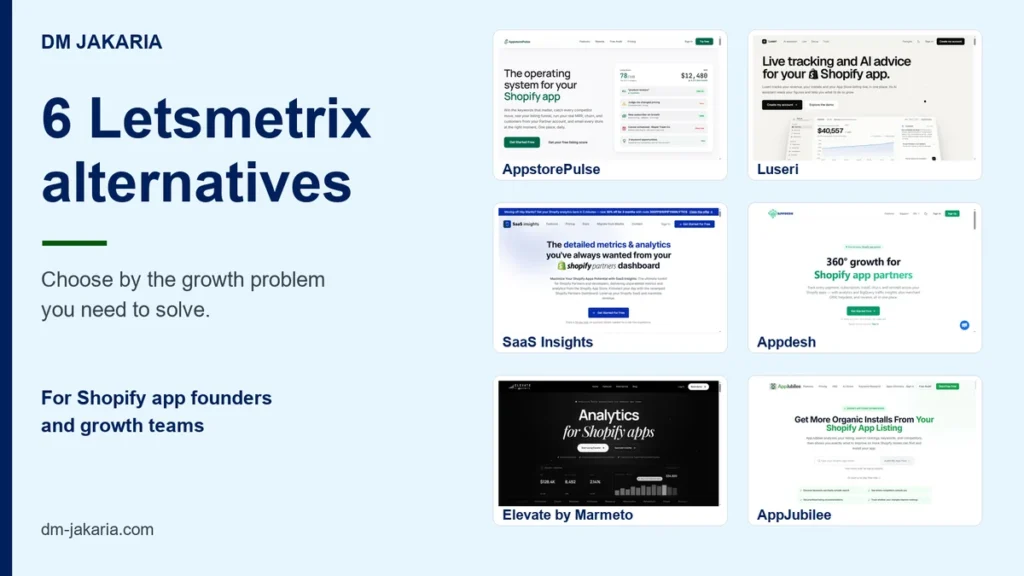
I’ve used AppDesh, LetsMetrix, SaaS Insights, and App Store Pulse for my client’s Shopify apps. Based on my experience, AppstorePulse good for App Store optimization and competitor monitoring. You can use AppDesh for tracking revenue, install, uninstall, and churn (completely free right now – Nov 2026). Luseri can be a Good options for analytics with AI guidance. And AppJubilee for keyword discovery and listing-change analysis.
Let me clearly mention that, I would not suggest any single tool as alternative. But depending on your needs, you can choose the best option after reading this post.
What Should a LetsMetrix Alternative Replace?
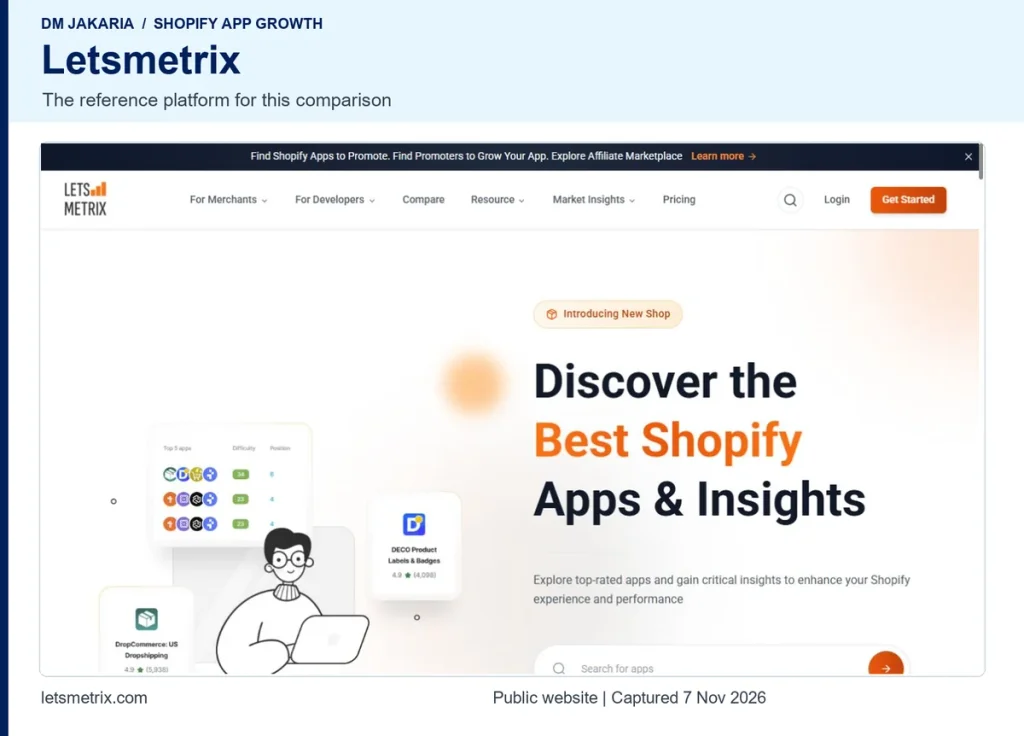
Letsmetrix combines Shopify App Store market research with tracking for your own apps. It can track keyword and category positions, listing changes, reviews, Shopify Partner revenue data, and Google Analytics 4 acquisition reporting.
It’s pricing start with a free plan, Pro at $19/month, and Studio at $49/month. That gives you a useful baseline before comparing another subscription.
Before switching, identify the specific gap you need to close.
Perhaps your team needs more detailed subscription reporting. Perhaps you want keyword opportunities organized around competing apps. Or you want merchant records close to your revenue data so support and growth teams can investigate the same account.
A tool can be a better fit for one of those jobs without replacing every Letsmetrix feature. If your replacement also needs to cover affiliate or partner management, my comparison of Mantle alternatives for Shopify apps covers that broader decision.
How I Selected These LetsMetrix Alternatives
I used 6 criteria to compare the platforms:
- Shopify app relevance. Does the platform serve app founders and partners, with reports that support their decisions?
- Visibility and competitor research. Can it track keywords, reveal competing apps, or preserve listing changes?
- Connection to business performance. Does it help you investigate listing conversion, trials, subscriptions, or retention?
- Data sources and setup. Which reports use public App Store observations, Shopify Partner data, Google Analytics, or additional integrations?
- Price and practical limits. What does the plan include for your app portfolio, keywords, history, and team?
- Current availability. Is the feature available now, restricted to a higher plan, or still on the roadmap?
These criteria matter because a keyword position, a listing visit, and a paid subscription answer different questions. Combining them carelessly can make a weak acquisition channel look successful.
6 Letsmetrix Alternatives at a Glance
| Platform | My recommended use case | Public pricing or access | Check before choosing |
|---|---|---|---|
| AppstorePulse | App Store optimization with competitor monitoring | Free; Starter $49/month; Pro $99/month | Keyword, history, and app limits |
| Luseri | Revenue and retention analytics with AI guidance | Currently free during early-user offer | Offer eligibility and required connections |
| SaaS Insights | Subscription, trial, and portfolio reporting | $49/month or $490/year; free below its stated revenue threshold | One Shopify Partner account per subscription |
| Appdesh | Free revenue analytics and merchant CRM | Advertised as free | Roadmap features versus available features |
| Elevate by Marmeto | Revenue operations and merchant context | Confirm current pricing with Marmeto | BigQuery setup and integration availability |
| AppJubilee | Keyword discovery and listing-change analysis | Starter $29/month; Growth $99/month | GA4 and Partner connections require Growth or above |
1. AppstorePulse
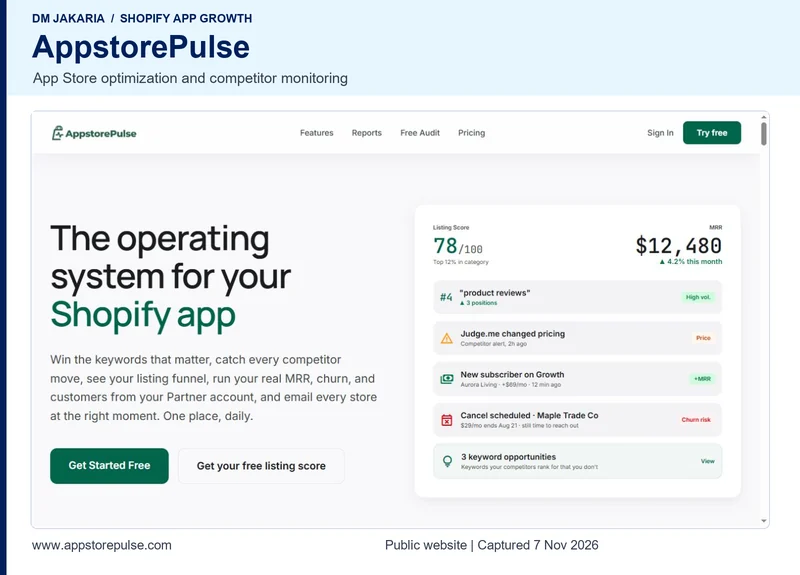
AppstorePulse is my first shortlist option when the immediate problem is understanding your app’s visibility and what competitors are changing.
It advertises daily keyword tracking, competitor listing alerts, AI listing audits, and listing-funnel reporting. Connected Shopify Partner data adds revenue and churn reporting.
Why it makes the shortlist
This combination suits a team that wants to investigate a ranking movement, inspect a competitor’s listing update, and decide which listing element to test next.
For example, if a relevant keyword starts slipping, review the competing apps and your listing’s promise before rewriting the description. A position change gives you a reason to investigate; the surrounding evidence helps you choose an action.
Pricing and Limitations
The free plan includes one app, three keywords, and one competitor. Starter costs $49/month for up to three apps and 20 keywords per app. Pro costs $99/month for up to ten apps and 100 keywords per app.
An important distinction: AppstorePulse describes its search-volume figures as estimated relative tiers derived from signals such as review velocity and search-result depth. Treat them as directional indicators when prioritizing keywords for your Shopify app.
My recommendation: Shortlist AppstorePulse if your team needs a regular ASO workflow. ASO means App Store optimization: improving how relevant merchants discover and evaluate your app.
2. Luseri
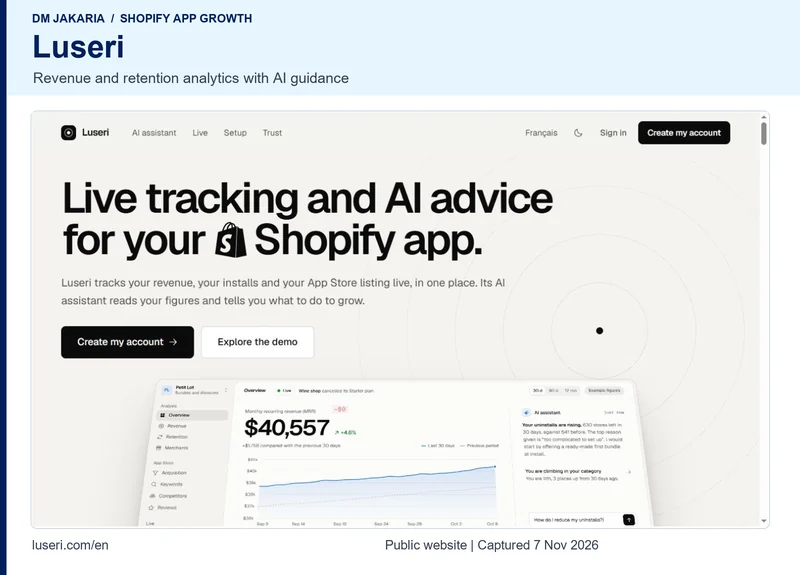
Luseri suits founders who want help interpreting their numbers alongside the reports themselves.
Its public site describes revenue analytics, retention cohorts, uninstall reasons, competitor tracking, and an AI assistant that answers questions using your app’s data. It also offers optional tracking of activity inside your app.
Why It Makes the Shortlist
The useful decision here is whether to increase your Shopify App Store ad budget or investigate what happens after installation.
If new installs are healthy but paid subscriptions remain flat, inspect whether merchants finish setup and reach the first useful outcome. An assistant can help organize that investigation, provided you check its reasoning against the underlying records.
Pricing and Limitations
Luseri currently advertises free access for early users, with accounts created during that period remaining free for life under its stated offer.
It explicitly says it does not handle billing or affiliates and does not provide keyword search volume or difficulty. Google Analytics is optional, while deeper product-usage reporting requires instrumentation in your app.
My recommendation: Choose Luseri for a founder’s analytics workflow where interpretation is a priority. During evaluation, ask it to explain a real revenue or retention change and verify that explanation yourself.
3. SaaS Insights
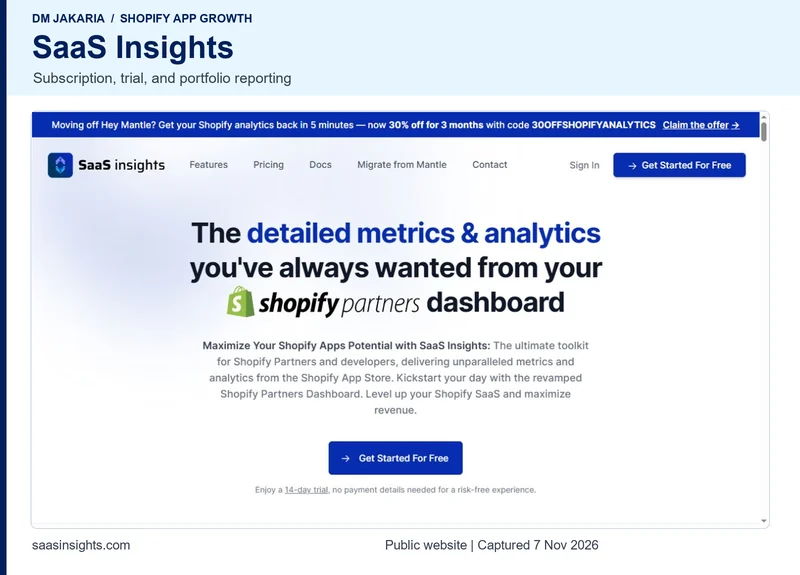
SaaS Insights is worth shortlisting when you need a clearer view of how installs become subscriptions and how those subscriptions change over time.
Its published features cover monthly recurring revenue (MRR), trials, customer timelines, retention tables, revenue churn, and custom reports. It also includes App Store keyword monitoring and listing analytics.
Why It Makes the Shortlist
This is a useful fit when your growth discussion needs to move beyond the install count.
Use a trial report to identify a weak conversion segment, then inspect the associated merchant records and onboarding experience. If one plan attracts many trials but few paying customers, investigate whether the offer and setup experience match those merchants’ needs.
Pricing and Limitations
Published pricing is $49/month or $490/year. The site offers a 14-day trial and says usage is free until you earn $2,500 per month. Unlimited apps are included under one Shopify Partner account. Confirm how the revenue threshold applies to your account before relying on the free offer.
My recommendation: Consider SaaS Insights when subscription performance and portfolio reporting drive your weekly decisions. Check its metric definitions before comparing figures with another dashboard.
4. Appdesh
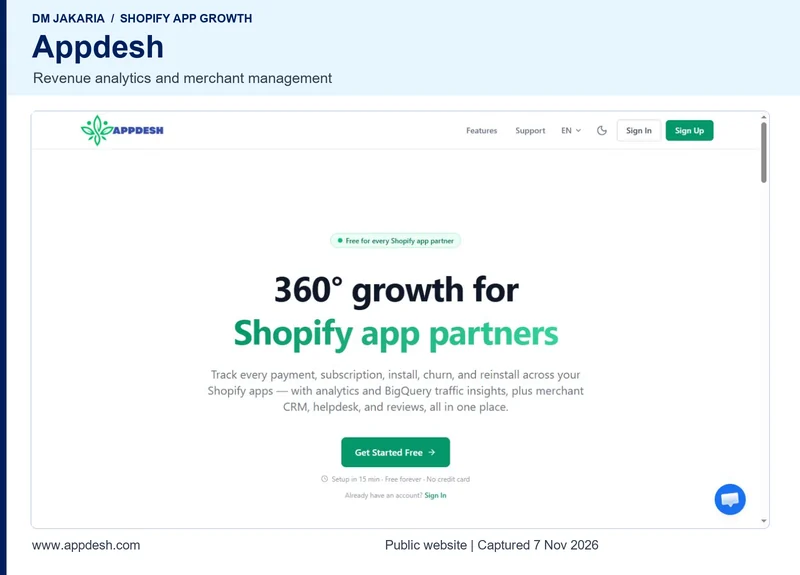
Appdesh is worth evaluating when you want revenue reporting and merchant records together without committing to a paid subscription.
Its public site advertises Shopify Partner API analytics, MRR and churn reporting, a merchant customer relationship management system (CRM), and team access. It currently promotes the platform as free.
Why It Makes the Shortlist
Merchant context helps you move from a revenue change to an account-level investigation.
For example, when a valuable merchant cancels, review their plan, install history, and available account notes before deciding what follow-up would be useful. This is especially relevant when the founder and support team need a shared understanding of the customer.
Pricing and Limitations
Appdesh’s feature messaging requires care. I have talked with Irfan Ahmed, the founder of the AppDesh. He confirmed me that customer helpdesk, feature flags and experiments, and additional integrations are coming soon.
My recommendation: Evaluate Appdesh for its available analytics and merchant management. Confirm any roadmap feature in the product before making it part of your operating process.
5. Elevate by Marmeto
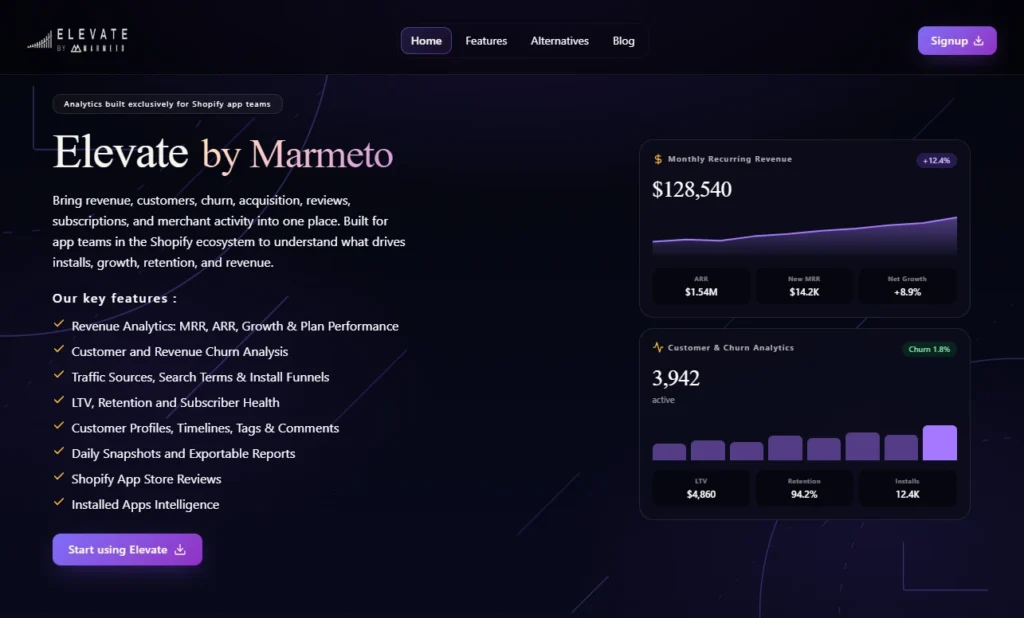
Elevate is an option for teams that want to investigate revenue, retention, and merchant activity in one operating view.
Its site describes MRR, annual recurring revenue, customer and revenue churn, merchant timelines, reports, exports, and Slack updates. It also promotes install-source reporting, with BigQuery identified as a connection for channel and campaign data.
Why It Makes the Shortlist
This suits a team asking where revenue is being gained or lost and which merchants need attention.
If you’re evaluating which paid campaigns drive Shopify app installs, use the demonstration to follow one source through to actual merchant records. Check whether the available data supports the decision you want to make about that source.
Pricing and limitations
Confirm current pricing directly with Marmeto. I could not establish an unambiguous current plan table from the publicly readable product pages.
Feature availability also needs confirmation: the homepage labels API and webhooks “coming soon” in its comparison table while promoting them elsewhere on the same page.
My recommendation: Shortlist Elevate for revenue operations. Ask for a demonstration of your required integrations and clarify the BigQuery setup before choosing it for attribution reporting.
6. AppJubilee
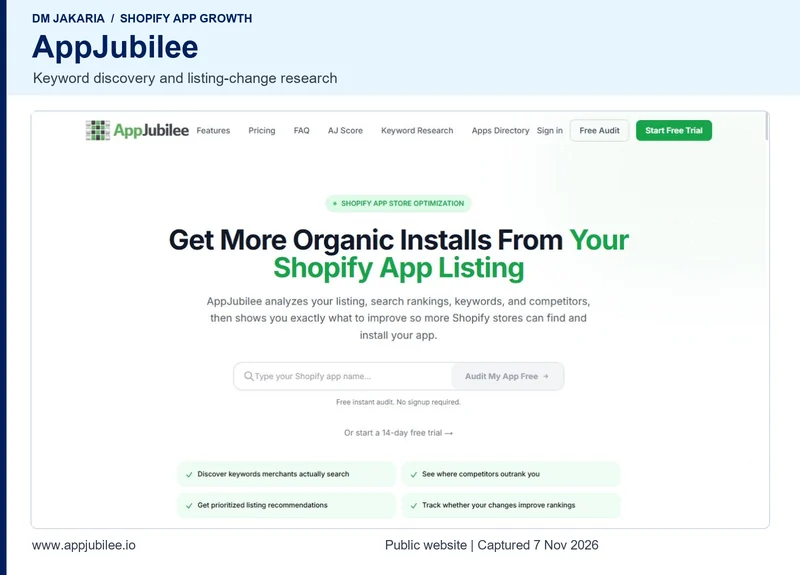
AppJubilee is a practical candidate when you want to discover keyword gaps and examine listing changes alongside ranking trends.
The AppJubilee blog publishes content about Shopify App Store ranking intelligence. Its separate product site describes daily keyword tracking, automatic keyword discovery, competitor monitoring, and listing-change analysis. Though I have not used this one, I have only research and verified public data from their website.
Why It Makes the Shortlist
This supports a repeatable research process: identify a relevant keyword opportunity, document your current listing, make a focused change, and review what follows.
The key is relevance. A competitor ranking for a term does not automatically make that term worth targeting. Read the merchant intent behind the query and check whether your product delivers what those searchers expect.
Pricing and Limitations
The current pricing page lists Starter at $29/month for one app. Growth costs $99/month for three apps and adds GA4 and Shopify Partner connections.
Listing-change analysis can show that an edit and a ranking movement happened near each other. You still need to consider competing changes and traffic conditions before attributing the movement to that edit.
My recommendation: Shortlist AppJubilee if your team already has revenue reporting and needs a more structured ASO research process.
Helpful FREE Resource: AppNavigator
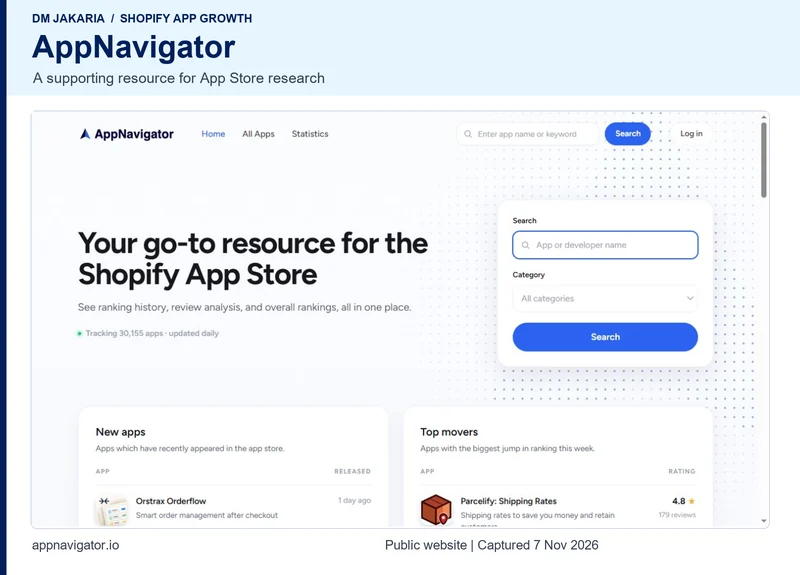
AppNavigator is useful for browsing Shopify apps, ranking history, review analysis, new apps, and recent movers.
I would use it as an additional research source when building a competitor shortlist or checking whether another app’s momentum deserves a closer look.
There is an important measurement detail: AppNavigator’s overall ranking is its own calculated metric, combining category standing with review volume. It is not an overall rank supplied by Shopify.
Its about page also says data may lag the App Store by up to 24 hours.
Use those signals to generate research questions. Verify the individual listing and relevant reviews before acting on them.
How to Choose the Right Tool for Your App
Choose according to the constraint you can identify today:
| Your current problem | Start your evaluation with | What to verify |
|---|---|---|
| Competitors are gaining search visibility | AppstorePulse or AppJubilee | Coverage of your important keywords and competing apps |
| Installs grow, but paid subscriptions stay flat | SaaS Insights or Luseri | Trial outcomes and merchant records behind the totals |
| Revenue changes are hard to investigate | SaaS Insights or Elevate | Metric definitions and account-level context |
| You need basic analytics within a limited budget | Appdesh or Luseri | Available features and the terms of free access |
| You need wider market context | Add AppNavigator | What each ranking metric measures |
Before committing, run one practical evaluation:
- Write down one decision. For example, “Should we improve onboarding before increasing our ad budget?”
- Establish a baseline. Record listing visits, completed installs, and paid conversions using clearly defined periods.
- Connect the necessary data. Confirm which reports depend on Partner access, GA4, BigQuery, or product events.
- Investigate a real event. Follow a ranking drop, cancelled trial, or revenue change through the records.
- Check the next action. The report should help you decide what to inspect or change and how you will measure the result.
Keep conversion calculations consistent. If you’re measuring install-to-paid conversion, define the install cohort and allow each merchant the same time to convert. Dividing this month’s new subscriptions by this month’s installs can mix merchants acquired in different periods.
Frequently asked questions
Which Letsmetrix alternative is best for Shopify App Store optimization?
My shortlist is AppstorePulse for monitoring keywords and competitor activity, and AppJubilee for keyword discovery and listing-change research. Compare both against your existing workflow and the queries your ideal merchants actually use. Their published capabilities overlap, so focus your evaluation on required coverage and plan limits
Are there free Letsmetrix alternatives?
Yes. AppstorePulse has a limited free plan, Appdesh is completely free, and Luseri currently offers free early-user access. SaaS Insights also advertises free usage below its stated revenue threshold. Check the terms and limits for each offer. Letsmetrix itself has a free plan
Which alternative should I consider for MRR and retention reporting?
Start with SaaS Insights, AddDesh, or Elevate. All of them offers revenue and retention reporting. Compare calculation methods, required connections, and available merchant detail before choosing.
Can I see a competitor’s actual installs and revenue?
Public ranking, review, and listing observations do not establish a competitor’s actual installs or revenue. Treat third-party estimates as estimates. For your own app, check which figures come from connected Shopify Partner or analytics data and which are calculated by the tool.
Will switching tools improve my app’s rankings or installs?
Switching gives you a different way to investigate performance. Improvement depends on what you learn, which changes you make, and whether those changes help relevant merchants discover your app and reach value. Track paid conversion and retention alongside visibility.
Is AppNavigator a complete replacement for Letsmetrix?
I regularly use it as a supporting market-research resource. Its has strengths like public ranking history and review information. But you can’t use as completely alternative of LetMetrix.
Choose a tool around your next growth decision
Choose the report that helps you act on the next priority in your Shopify app marketing strategy. For one founder, that means understanding keyword opportunities. For another, it means identifying why otherwise qualified merchants leave before paying.
Choose one platform to evaluate, investigate a real problem, and document the action its data supports. That will tell you more than a long feature checklist.
If your Shopify app already has traction and you’re unsure where growth is slowing, I can review the path from discovery to paid conversion and help identify the next priority.