
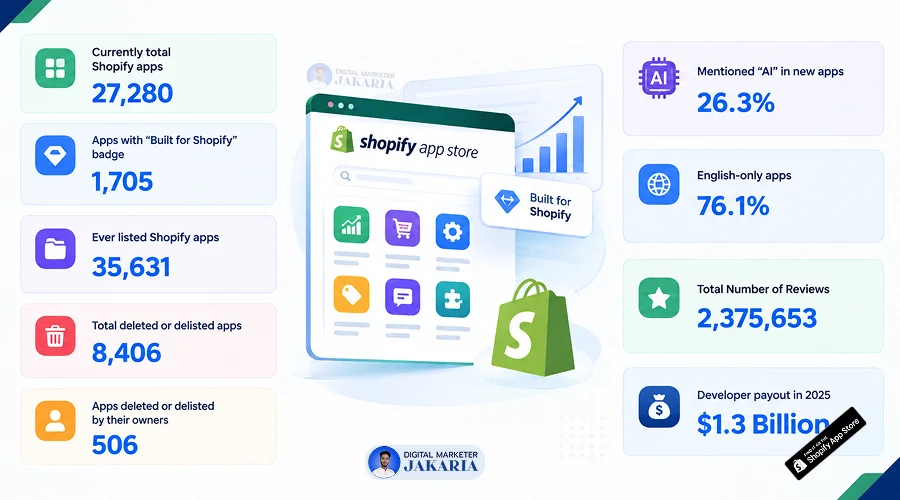
As of today, 29 September 2026, there are 27,280+ live Shopify apps by 11,000 partners in the app store. When I entered the Shopify app store ecosystem in 2024, there were fewer than 11,000 apps.
In February 2026, I noticed that 150+ Shopify apps are getting published every week. Seeing that many apps made me concerned about the marketplace and ecosystem.
That’s why I have started tracking new Shopify app publishing velocity. I’ve found a lot of insights and interesting data you shouldn’t miss.
If you have any live Shopify app(s), or are thinking of building a new app, this post will help you a lot. Because I will not only share states of Shopify app store, but also share my experience in Shopify app growth, how the market is changing, and how Shopify app partners can survive in this competitive market.
Shopify App Store Statistics at a Glance
| Metrics | Number |
| Currently total Shopify apps | 27,280 |
| Apps with “Built for Shopify” badge | 1,705 |
| Ever listed Shopify apps | 35,631 |
| Total deleted or delisted apps | 8,406 |
| Apps deleted or delisted by their owners | 506 |
| Mentioned “AI” in new apps | 26.3% |
| English-only apps | 76.1% |
| Total Number of Reviews | 2,375,653 |
| Developer payout in 2025 | $1.3 Billion |
Shopify App Store statistics highlight rapid market expansion across the Shopify apps ecosystem. Over 11,000 unique developers actively build and maintain these products.
Merchant demand remains strong across every operational category. About 87% of store owners rely on third-party software to power daily sales. Standard stores average six active apps, while enterprise stacks often exceed thirty tools.
How Many Apps Are on the Shopify App Store in 2026?
According to the most trusted go-to resource for the Shopify App Store, there are 27,280 apps at the end of September 2026. You may find the app count is different on different platforms. But the difference won’t be too much.
Officially, Shopify doesn’t have any live tracker, and they haven’t updated the number of apps on the platform. Still now they are saying that there are 16,000 apps.
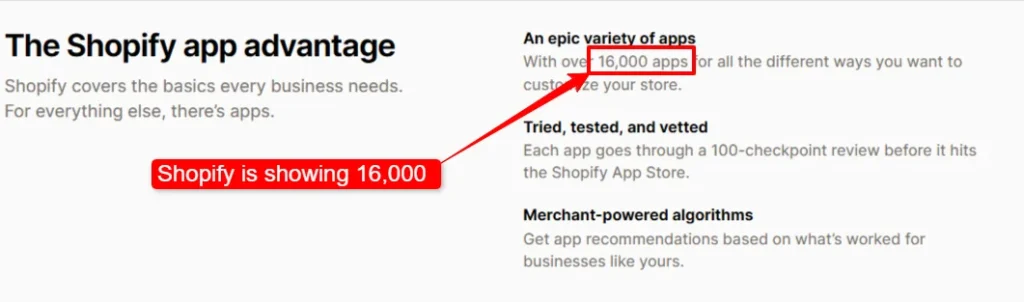
The actual number is 1.6x times more than the number they are showing. The exact count of Shopify tools varies across independent tracking databases.
Why Different Sources Report Different Numbers
Tracking indices record distinct metrics based on how they crawl and classify software listings:
- Live Public Listings: Scrapers count public tools accessible directly via storefront browse pages.
- Published Apps: Indexes record total developer submissions, including unlisted tools, draft software, and legacy items.
- Historical Listings: Analytics databases retain deprecated applications, store removals, and deleted vendor accounts.
- Cataloged Technologies: Store scanners identify software by detecting active JavaScript snippets across live merchant storefronts.
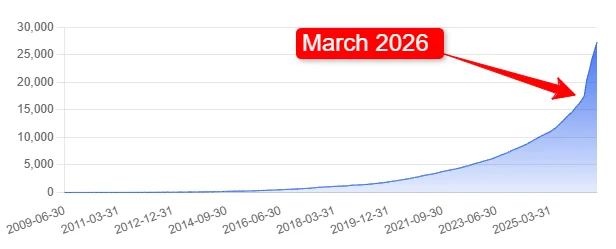
Historical Growth of the Shopify App Store.
Shopify App Store Growth Timeline
The explosive expansion of the Shopify ecosystem over 5+ years
The number of apps has increased steadily over the years. More developers, agencies, and software companies have joined the ecosystem to solve specific merchant needs.
This growth has also made the App Store more competitive. Today, launching an app is not enough. App publishers need clear positioning, strong differentiation, positive reviews, and better discoverability to attract merchants and grow installs.
Shopify App Store Growth: How Fast Is the Ecosystem Expanding?
The Shopify app marketplace shows long-term expansion driven by steady developer activity.
Total public tools grew from roughly 4,000 apps in 2020 to over 23,500 active listings in mid-2026. High market expansion reflects low entry barriers and steady demand from growing stores.
Net app ecosystem growth depends on new app launches versus app removals. Data from AppstorePulse recorded 2,001 app launches alongside 55 app removals in June 2026 alone.
High monthly launches expand total choices, but the raw count alone can be misleading.
- Gross Monthly Launches: 2,001
- Gross Monthly Removals: 55
- Net Monthly Expansion: 1,946 apps
Market analytics provider LetsMetrix tracks live apps separately from historically listed apps. Their historical datasets show that thousands of published tools gradually lose merchant installs or exit public directories.
Measuring long-term app health requires tracking active retention, review velocity, and ongoing code updates rather than gross index totals.
Shopify App Store AI Statistics
AI integration across the Shopify ecosystem represents a core structural shift for developers and merchants alike.
What Percentage of Shopify Apps Use AI?
As of mid-2026, 19.8% of live apps mention AI in their name, tagline, or description.
AI Is Growing Faster Among New Apps
Newer entries adopt AI terms at higher rates than older listings. Data shows 26.3% of June 2026 launches mention AI features, compared to 19.8% across the total live catalogue.
- Live Catalogue AI Mention Share: 19.8%
- New June 2026 Launch AI Share: 26.3%
What This Statistic Does and Doesn’t Mean
This metric measures explicit AI-related language inside the public listing text. It doesn’t prove an application is built on native machine learning models or custom AI architecture.
AppstorePulse explicitly notes this distinction to separate promotional copy from underlying software design.
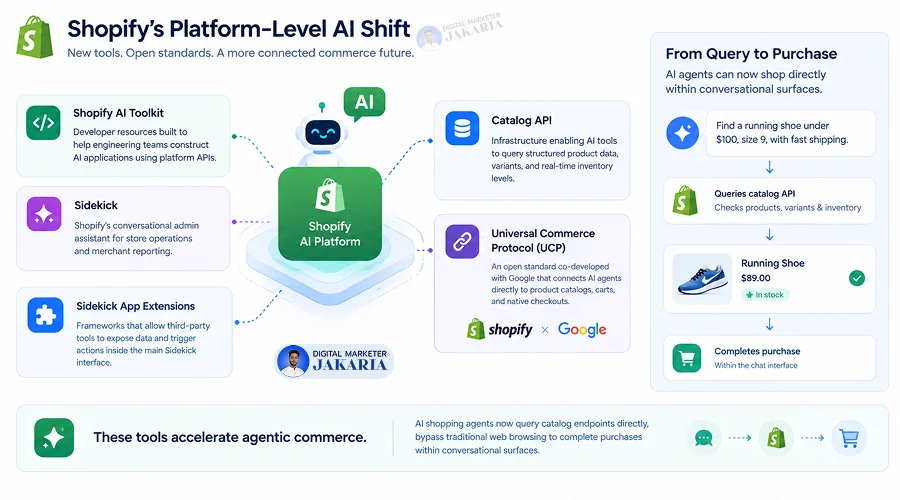
Shopify’s Platform-Level AI Shift
Shopify’s 2026 developer updates made agentic-commerce tooling accessible to the broader developer ecosystem. Core infrastructure updates include:
- Shopify AI Toolkit: Developer resources built to help engineering teams construct AI applications using platform APIs.
- Sidekick: Shopify’s conversational admin assistant for store operations and merchant reporting.
- Sidekick App Extensions: Frameworks that allow third-party tools to expose data and trigger actions inside the main Sidekick interface.
- Catalog API: Infrastructure enabling AI tools to query structured product data, variants, and real-time inventory levels.
- Universal Commerce Protocol (UCP): An open standard co-developed with Google that connects AI agents directly to product catalogs, carts, and native checkouts.
These tools accelerate agentic commerce. AI shopping agents now query catalog endpoints directly, bypassing traditional web browsing to complete purchases within conversational surfaces.
What Are the Most Popular Shopify App Categories?
Popularity on the Shopify App Store splits into two distinct metrics: software availability and actual merchant engagement.
Biggest Categories by App Count
Catalog size reflects total developer supply across specific software niches. According to AppstorePulse, the ten largest categories by total live listings are:
- Analytics: 1,080 live apps
- Chat: 772 live apps
- SEO: 754 live apps
- Shipping: 749 live apps
- Discounts: 731 live apps
- Upsell and Cross-Sell: 560 live apps
- Dropshipping: 517 live apps
- Inventory Sync: 447 live apps
- Delivery and Pickup: 421 live apps
- Cart Customization: 414 live apps
Categories with the Most Review Demand
Total merchant review counts signal actual adoption and ongoing user feedback rather than raw supply. AppstorePulse’s category data reveals that review volume shifts focus toward core store operations:
- Product Reviews (Led by tools like Judge.me)
- SEO
- Product Variants
- Dropshipping
- Marketplaces
Supply Doesn’t Equal Demand
A high app count indicates a crowded category, but it does not guarantee high merchant adoption.
For instance, Analytics holds the largest number of listings, yet individual Analytics apps average far fewer reviews per product than smaller categories.
Conversely, the Product Reviews category contains relatively few overall listings but generates massive review volume per app.
Developers who evaluate market entry based solely on catalog size often miss true merchant demand signals.
Which Shopify App Categories Are Most Saturated?
Market saturation in the Shopify App Store is not uniform. Certain categories face extreme developer crowding with thousands of listings competing for attention, while others sustain high merchant demand relative to the total number of options available.
The table below maps developer supply against merchant engagement and market velocity using datasets from AppstorePulse alongside competition analysis principles from LetsMetrix:
| Category | Apps | Reviews | Reviews/App |
| Analytics | 1,080 | 18,420 | 17.0 |
| SEO | 754 | 89,450 | 118.6 |
| Chat | 772 | 32,110 | 41.5 |
| Shipping | 749 | 28,600 | 38.1 |
| Discounts | 731 | 42,300 | 57.8 |
| Upsell & Cross-Sell | 560 | 64,200 | 114.6 |
| Product Reviews | 312 | 198,500 | 636.2 |
Crowded Categories
- Analytics: Analytics is the single largest category by total listings (1,080 apps) and leads in new monthly additions (188 new launches).
However, its low average review count per app (17.0) reveals severe long-tail fragmentation where most tools fail to gain meaningful merchant traction. - SEO: SEO tools remain heavily saturated with 754 live listings. Unlike Analytics, SEO generates significant review volume (118.6 reviews/app), but market share stays heavily concentrated among established market leaders.
- Shipping & Delivery: With 749 live apps, Shipping features high developer entry. Growth slowed to 50 new monthly launches due to complex API integrations, carrier requirements, and strict merchant reliability demands.
- Chat & Customer Support: Chat listings expanded to 772 tools. Recent AI growth sparked 112 new launches in a single month as developers rushed to publish wrapper tools around conversational LLMs.
- Discounts & Promotions: Discount tools account for 731 listings. The launch of Shopify Functions lowered the barrier to build custom promotion logic, driving continued entry despite high feature overlap.
Why App Count Alone is a Bad Competition Metric
Raw app count measures developer supply, not market difficulty. Evaluating true market saturation requires analyzing how merchant attention and authority spread across a given category.
Competitive intelligence tools like LetsMetrix combine five key structural signals to evaluate real category difficulty:
- Review Concentration: A category where 90% of reviews belong to the top 3 apps is vastly harder to enter than one where reviews split evenly across 50 tools.
- Leader Authority: Incumbents with thousands of 5-star ratings, official badges, and deep platform integrations create massive entry barriers regardless of total catalog size.
- Survival Rates: Categories with high monthly launch volume often exhibit high churn and removal rates, indicating that new entries fail to sustain recurring revenue.
- Review Velocity: The speed at which top apps acquire new reviews signals active merchant acquisition rates versus stagnant legacy installs.
- Category Fragmentation: Highly fragmented categories lack a clear market leader, giving specialized niche tools a viable entry point despite high overall app counts.
How Many Shopify Apps Have Reviews?
Merchant reviews serve as direct proof of usage across the Shopify App Store. While thousands of applications fill the catalog, total customer feedback stays heavily concentrated among a small group of market leaders.
The Shopify App Review Distribution
A large portion of published applications receive zero merchant reviews after listing:
- 51% with zero reviews: RevenueHunt June snapshot dataset.
- 57.9% with zero reviews: GapQuery August 17 snapshot dataset.
Why These Numbers Differ
Different tracking tools report varying zero-review percentages because their data collection rules diverge:
- Catalog Scope: GapQuery indexes every published app ID ever registered, including unlisted, deprecated, and newly submitted draft software.
- Active Filter: RevenueHunt filters its snapshot to public apps that actively maintain public storefront pages, removing unlisted tools.
- Crawl Frequency: Scrapers that update daily capture zero-review apps immediately upon launch, whereas monthly sweeps give new listings more time to collect their first feedback.
How Hard is It to Reach 50 Reviews for a Shopify App?
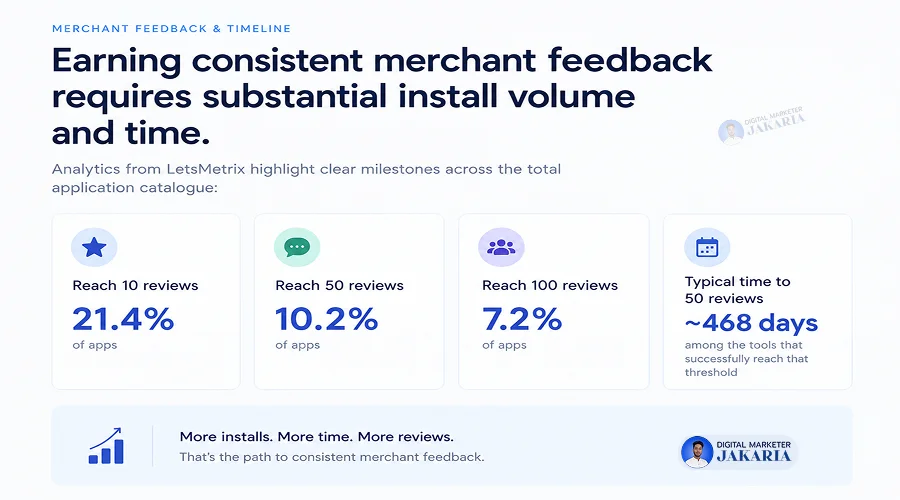
Earning consistent merchant feedback requires substantial install volume and time. Analytics from LetsMetrix highlight clear milestones across the total application catalogue:
- Reach 10 reviews: 21.4% of apps
- Reach 50 reviews: 10.2% of apps
- Reach 100 reviews: 7.2% of apps
- Typical time to 50 reviews: ~468 days among the tools that successfully reach that threshold
How Much Do Shopify Apps Cost?
Shopify app costs vary wildly, so simple averages rarely reflect reality. Prices depend heavily on functionality, ranging from basic free utilities to enterprise platforms charging thousands monthly.
Median vs Average Shopify App Pricing
Average prices distort true software costs because enterprise tools pull the number up.
- Median paid app price: $9.99/month
- Average paid app price: $31.80/month
ShopThemeDetector excludes free apps from this paid calculation. The gap between $9.99 and $31.80 proves high-cost enterprise apps skew the average.
Free vs Freemium vs Paid-Only
Metrics from LetsMetrix show three distinct revenue models across the store:
- Free only: 31% of live apps
- Freemium: 35% of live apps (Free tier with paid upgrades)
- Paid only: 34% of live apps
Why “Average App Cost” is Misleading
Quoting a flat “average cost of $58–$67” ignores real merchant spending habits. App expenses vary based on several clear factors:
- Free Apps: Over 31% of apps charge nothing, giving merchants basic store tools at zero cost.
- Free Trials: Most freemium and paid tools offer 7 to 14 days free before starting subscriptions.
- Entry Tiers: Small stores usually stay on entry plans costing $5 to $15 monthly.
- Usage-Based Pricing: Email, SMS, and shipping apps bill per message or order processed, so costs shift with store volume.
- Enterprise Plans: High-volume Shopify Plus stores needing custom limits and extra security pay $500 to $2,000+ monthly.
How Many Shopify Apps Do Merchants Use?
StoreCensus tracks over 13.1 million app installs across its database. Data from the tracker shows an average of 6.2 apps per store.
That average number can be deceiving. It doesn’t mean every store runs six apps. Actual usage varies wildly depending on store size and operational needs.
Lean Stores vs Complex Tech Stacks
Store app stacks grow with business size and operational complexity. Clear extremes exist between simple setups and heavy tech stacks:
- 18% of stores run zero third-party apps. They rely purely on built-in platform features.
- 12% of stores run 10 or more apps. They build complex tech stacks for specialized needs.
New businesses often keep their Shopify app usage low to save money. Bigger brands use larger app stacks to handle rewards, subscriptions, and complex inventory.
App Stack Complexity and Performance
App additions provide extra tools, but they can hurt site speed. ShopThemeDetector tracks how total app counts impact store performance through Core Web Vitals.
Data links higher app counts to slower load times. However, correlation does not prove causation.
Extra apps might slow a site down, but bad code, huge images, or poor themes often cause the lag instead. Regular evaluation of every tool in a Shopify tech stack keeps storefronts running fast.
Which Shopify Apps Have the Most Merchant Adoption?
Real software popularity shows up in active store installations, not simple review totals. Modern crawlers inspect live store scripts and storefront tags to verify true software usage across the web.
Data from Store Leads highlights the top public tools by active installation counts:
- Judge.me: 637,666 active installs
- Klaviyo: 430,607 active installs
- Shopify Inbox: 358,983 active installs
- Klarna On-Site Messaging: 355,433 active installs
- Instafeed: 243,786 active installs
Coverage metrics from StoreCensus confirm this same top-tier dominance. Their index records Judge.me leading all third-party software with 399,118 active installs across observed stores.
Install Count ≠ Review Count ≠ Revenue ≠ Active Usage
Each performance metric tracks a completely different aspect of app performance:
- Install Count: This metric measures active code scripts running on live store sites.
- Review Count: Public feedback density signals merchant engagement, which heavily favors free tools with aggressive rating prompts.
- Revenue: Total business volume depends on pricing strategy, as specialized enterprise apps with 200 high-paying clients easily out-earn free apps with 50,000 installs.
- Active Usage: Daily feature utilization varies widely because merchants frequently leave installed scripts running without opening the app dashboard for months.
Built for Shopify Statistics
Shopify highlights top-tier applications through its official quality recognition program. Badged tools pass strict performance benchmarks to earn premier placement across the platform.
How Many Built for Shopify Apps Are There?
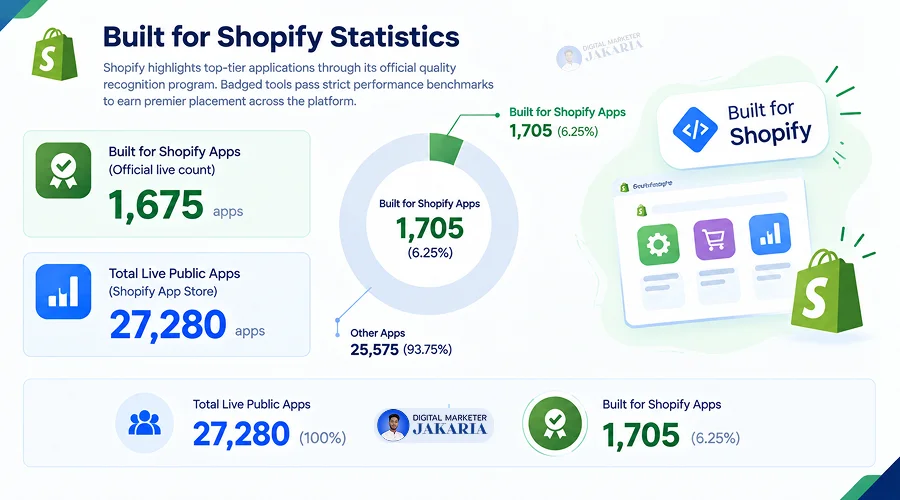
Only a small fraction of public applications successfully earn and maintain this status. Current inventory counts reflect high selectivity:
- 1,675 apps: Official live count on Shopify’s dedicated App Store collection.
Total Live Public Apps: 27,280 (100%)
Built for Shopify Apps: 1705 (6.25%)
What Built for Shopify Actually Means
Shopify calls Built for Shopify its highest level of app recognition. Applications must pass ongoing automated tests and manual design checks to earn the badge. Core evaluation pillars include:
- Safety: Software must uninstall cleanly using Theme App Extensions without leaving orphan code behind. Systems must handle customer data securely and maintain high API reliability.
- Performance: Admin interfaces must load fast, meeting strict Core Web Vitals targets (LCP under 2.5s, INP under 200 ms). Storefront scripts cannot drop a merchant’s main page speed score by more than 10 points.
- Usefulness: Apps must meet a traction floor, holding at least 50 net active installs and 5 high-rating reviews before applying.
- UX & Design: Interfaces must integrate natively into the Shopify admin using Polaris components and modern user experience patterns.
Shopify rewards badged developers with distinct marketing perks. Qualified tools get dedicated badges on search cards, features inside admin recommendations, and direct promotion across App Store homepage collections.
Is Built for Shopify a Ranking Signal?
Yes, Shopify explicitly confirms that Built for Shopify status works as an internal search-ranking signal.
Official developer documentation states that badged apps receive preferential search algorithm placement over non-badged alternatives.
Search Placement Priority:
1. Paid App Store Ads (Sponsored slots)
2. Built for Shopify Badged Apps (Algorithmic Boost)
3. Standard Public Apps (Ranked by reviews, installs, and velocity)
However, ranking boosts do not guarantee total search dominance.
Third-party analysis shows that non-badged apps with massive historical review volume or high install velocity can still outrank badged tools for broad category terms.
The badge works as a heavy weight multiplier in Shopify’s internal algorithm, but store traction metrics still dictate final organic order.
Shopify App Developer Statistics
Thousands of software vendors build and maintain applications for the Shopify marketplace. Data from Q2 records 19,055 active developers operating within the platform ecosystem.
Single-App Developers: 91.2%
Multi-App Developers: 8.8%
Vendor structures range from solo engineers running individual side projects to large corporate teams managing multi-app portfolios. Most accounts list a single tool.
Portfolio concentration remains rare, though top agencies deploy dozens of specialized apps across different niche categories.
Geographic distribution spans global markets. Developer teams cluster heavily across North America, Europe, India, and Southeast Asia, creating round-the-clock competition across major app categories.
Shopify App Developer Revenue
First-party financial disclosures confirm Shopify paid developers over $1.3 billion in 2025.
Total active app installs expanded by nearly 20% year-over-year. Rising merchant store volume drives strong demand for subscription software and custom theme utilities.
Revenue Concentration
Note: The following metrics represent estimated, not reported revenue.
Earnings distribution follows a steep long-tail curve. Third-party research models from RevenueHunt estimate the top 1% of developers capture roughly 72% of total platform app revenue.
Top 1% Developer Revenue Share: 72%
Remaining 99% Revenue Share: 28%
RevenueHunt builds these estimates using public plan pricing, observed install counts, and rating velocity rather than private Shopify billing data.
Dominant software suites command huge market share, while thousands of smaller vendors share the remaining revenue pool.
Shopify App Store Localization Gap
Language support across the Shopify App Store remains heavily unbalanced.
Most developers build exclusively for English-speaking merchants, leaving non-English markets underserved.
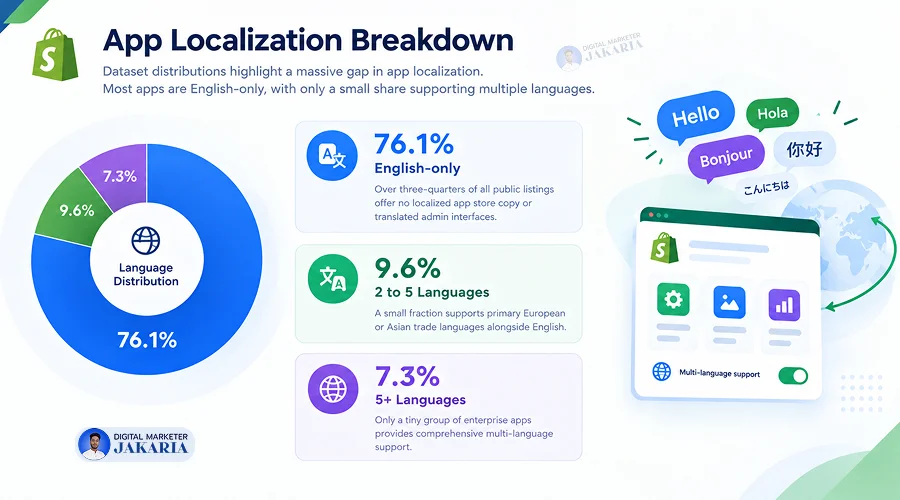
Dataset distributions highlight a massive gap in app localization:
- 76.1% English-only: Over three-quarters of all public listings offer no localized app store copy or translated admin interfaces.
- 9.6% with 2–5 languages: A small fraction supports primary European or Asian trade languages alongside English.
- 7.3% with 5+ languages: Only a tiny group of enterprise apps provides comprehensive multi-language support.
English-Only Apps: 76.1%
2 to 5 Languages: 9.6%
5+ Languages: 7.3%
Why Localization Matters
The gap between merchant location and app language creates clear opportunities for Shopify app developers.
Shopify continues to expand its international merchant footprint across Europe, Latin America, and Asia. Non-English store owners search for tools in their native languages to manage local operations.
Building multilingual app listings directly improves search discoverability in localized app store queries. Native language support lowers install friction, reduces user drop-off, and improves long-term review retention.
Developers who localize their app store copy and admin interfaces gain an immediate edge in non-English markets. These regional markets often face far less developer competition than saturated English-speaking segments.
Shopify App Store Trends to Watch Through 2027
Big changes are happening across the Shopify ecosystem. These updates change how developers build, launch, and grow their software. The old playbooks do not work anymore.
AI-Native App Development
Developers no longer need to write every line of code by hand. Shopify now offers an AI Toolkit. This tool gives AI coding assistants direct access to official docs, API schemas, and store commands.
Software teams now use tools like Cursor to build apps faster. They check GraphQL code and test theme changes in minutes. Technical work moves away from basic typing and shifts toward smart product design.
Agentic Commerce (Most Important)
Online shopping is moving beyond standard web browsers. AI agents now help shoppers find products, compare prices, and complete orders automatically.
Shopper Needs ──► AI Shopping Assistant ──► Catalog API / UCP ──► Instant Checkout
Key tools behind this shift include:
- Universal Commerce Protocol (UCP): A shared system built with Google. It lets AI assistants connect directly with store systems.
- Catalog API: A fast data pipe that sends real-time stock levels and prices to AI tools.
- Agentic Checkout: A feature that lets AI assistants buy items directly inside chat screens.
Apps Moving into Sidekick
Sidekick is the main AI helper inside the Shopify admin panel. Developers can now use Sidekick App Extensions. These tools connect app features directly to Sidekick.
Merchant Ask ──► Sidekick Chat ──► App Extension ──► Action Completed
Merchants no longer need to open five separate dashboards. They just type simple requests into Sidekick to run their apps. Tools that connect to Sidekick stay useful, while separate dashboards get ignored.
Quality Controls Search Ranks
Shopify app search algorithms now favor high quality over simple keyword tricks. Slow or poorly built apps get pushed down in search results.
Fast Load Speed + Clean Code + Easy Design ──► Built for Shopify Badge ──► Top Search Rank
Apps must load fast, uninstall cleanly, and use native design rules to earn the Built for Shopify badge. Badged apps get top search rankings, so product quality controls organic success.
The New App Opportunity: Fix Specific + Upcoming Pain Points
The days of launching simple wrapper apps are over. App Store data shows high competition, zero-review traps, and huge top-app dominance.
New developers should not launch another generic review or SEO app. Success comes from fixing real merchant’s problems. If you can’t identify and solve any problem, nobody will pay for your app. No matter how much effort and investment you put into it.
What Shopify App Store Statistics Cannot Tell You?
Public app metrics give developers and merchants high-level market signals, but they never tell the full story.
Relying strictly on surface-level numbers can lead to poor business decisions because public database counts leave out critical underlying details.
App Count Does Not Reveal Business Health
A massive catalogue size shows platform growth, but raw app counts do not measure developer success or software usage. Total app listings fail to show:
- Active Users: A store catalogue might list 27,000+ apps, but thousands sit abandoned with zero monthly active users.
- Revenue: High app numbers do not mean high platform payouts. A category with 500 apps might generate less total revenue than a niche category with just 10 tools.
- Retention: Public listing numbers do not show churn rates. An app can gain 100 installs a week while losing 95 stores over the same period.
- Profitability: A listing cannot show developer operating costs. Large support teams, high server bills, and heavy ad spend often turn high-revenue apps unviable.
- App Quality: High listing volume often signals category saturation rather than overall software excellence.
Review Count isn’t an Operational Metric
Public ratings offer social proof, but review totals do not track real operational scale. Review totals fail to measure:
- Exact Installs: Free apps with aggressive pop-ups often collect thousands of reviews from tiny stores, while enterprise tools with massive install bases stay under 50 reviews.
- Current Active Users: Review totals accumulate over many years. An app with 1,000 reviews might have lost 80% of its active store base over time.
- Revenue: High review counts rarely match high software prices. Free utility tools often lead review boards while generating zero subscription revenue.
AI Mentions Do Not Guarantee Value
Marketing copy inside app store listings often highlights AI features, but text keywords do not prove software capability. AI listing mentions fail to verify:
- AI Quality: A listing that claims “AI automation” may rely on simple hardcoded rules rather than smart algorithms.
- Actual Model Usage: App copy does not show whether a tool calls advanced language models or basic text templates.
- AI-Generated Value: Adding AI features does not guarantee a better merchant workflow or higher store sales.
Detected Installs Do Not Equal Shopify’s Official Ledger
Third-party tracking tools inspect public storefront tags and page scripts to estimate app installations. However, these external scans differ from Shopify’s internal partner database:
- Detection Limits: External scrapers miss headless stores, custom admin setups, and backend-only apps that run without visible frontend scripts.
- Delayed Scans: Crawlers update their indexes on daily or weekly schedules, while Shopify’s official internal ledger tracks installs and uninstalls in real time.
- Testing Noise: External detectors often pick up temporary staff, staging, and development stores, which inflates true active merchant numbers.
Final Thoughts
After reading all Shopify App Store statistics and insights, you may be scared a bit. Maybe you are thinking that the market has been too saturated and there are no more opportunities.
But from my experience, I still wouldn’t say that you have no opportunities. Definitely, the market has changed, and changing too fast. But not died yet.
You know, there are millions of Shopify stores. Every store is struggling with its own unique problems.
So, you need to identify their actual problems, then solve them to succeed in this competitive market,
Don’t build any Shopify app that has been available since 2020. Try to find out what new problems and challenges are arising now that haven’t been solved yet. Solve the problem with your app that will help merchants.
Recently, I have tried to grow 2 Shopify apps in a crowded category, you can learn my real challenges.
FAQs
1. How fast is the Shopify App Store growing?
The Shopify App Store has expanded significantly over the years. More developers, agencies, and software companies continue to build apps as Shopify’s merchant ecosystem grows.
2. How many Shopify apps are added each year?
The number of new apps added varies from year to year. Historical App Store data shows continued growth as more developers enter the Shopify ecosystem and create solutions for specific merchant needs.
3. What are the most popular Shopify app categories?
Popular categories include marketing, sales and conversion, orders and shipping, store design, customer support, and inventory management. Category popularity can change as merchant needs and Shopify’s ecosystem evolve.
4. How competitive is the Shopify App Store?
Popular categories include marketing, sales and conversion, orders and shipping, store design, customer support, and inventory management. Category popularity can change as merchant needs and Shopify’s ecosystem evolve.
5. How many merchants use Shopify apps?
Shopify merchants can use apps to extend their stores with additional features and integrations. However, the number of merchants actively using apps varies by app and category, so there is no single figure that represents app usage across the entire App Store.
6. Why are Shopify App Store statistics important for app developers?
These statistics help developers understand the size, growth, and competitive landscape of the Shopify app ecosystem. They can also help app companies identify market opportunities, evaluate competition, and make better decisions about ASO, SEO, product positioning, and customer acquisition.